

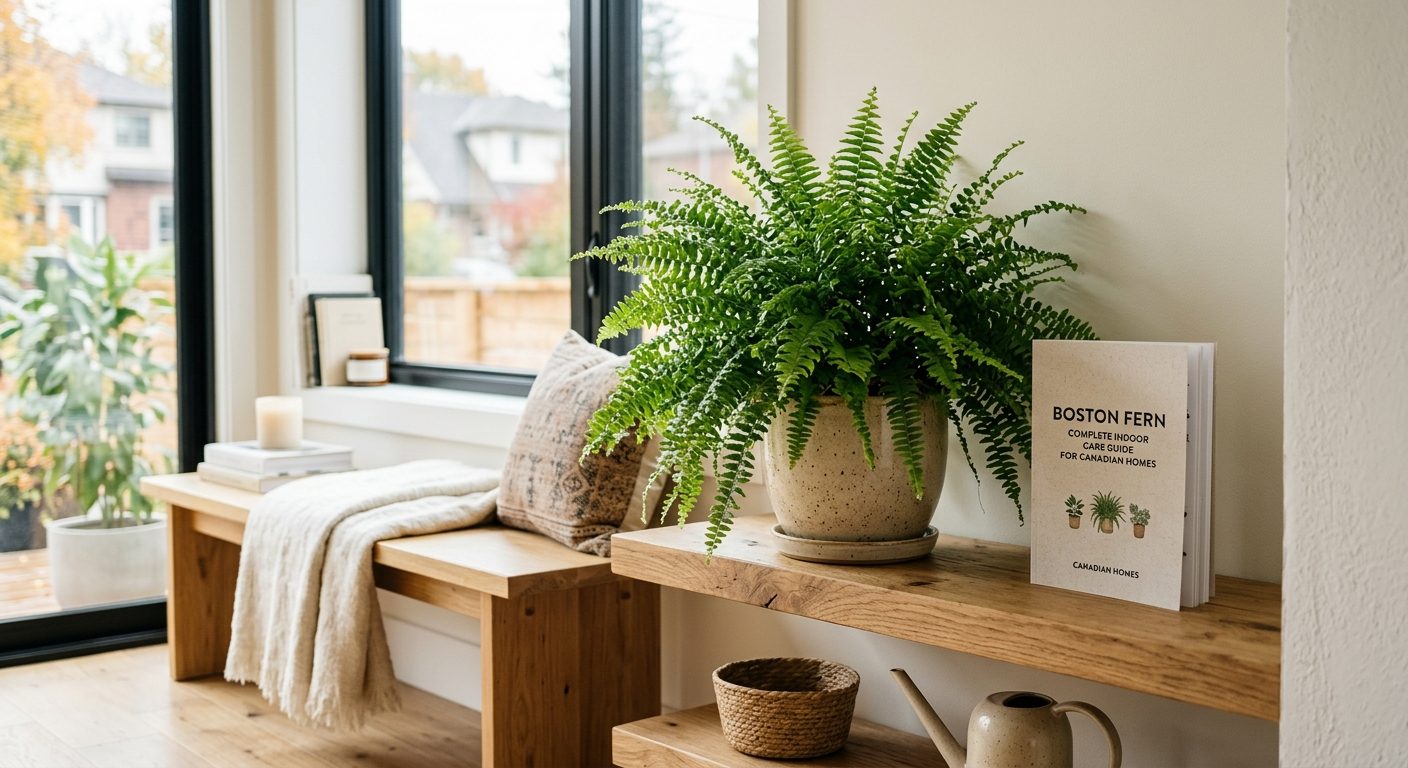
Boston Fern: A Shallow-Rooted Epiphyte for Canadian Homes
The Boston Fern (Nephrolepis exaltata) stands apart from terrestrial houseplants like Pothos or ZZ Plant because of its epiphytic ancestry. In tropical forests from Florida to Central America, wild Nephrolepis clings to tree bark and decomposing logs, anchoring with a shallow, fibrous root system that absorbs moisture from humid air and rain runoff rather than deep soil reserves. When you bring a Boston Fern into your Montreal apartment or Vancouver condo, you inherit these physiological constraints: the plant cannot store water in thick roots or succulent leaves, so it depends on you to maintain consistent moisture and humidity above 50%. Across Ontario (zone 5b) and British Columbia’s coastal zone 8, indoor growers report that Boston Ferns flourish in bathrooms, kitchens, and humidified living rooms but decline rapidly in forced-air heated bedrooms where relative humidity drops below 40% in winter. This guide quantifies light thresholds in foot-candles, prescribes soil-moisture-sensor protocols instead of calendar watering, and maps symptom patterns-frond-tip browning, sparse pinnae, yellowing-to their root physiological causes, so you can troubleshoot with precision rather than guesswork.
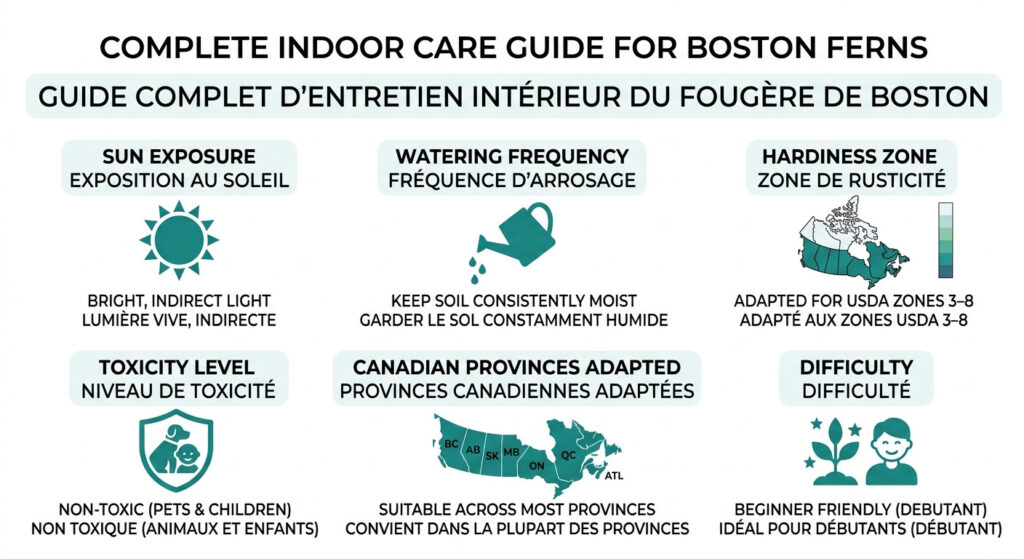
| Characteristic | Value |
|---|---|
| Botanical name | Nephrolepis exaltata |
| Plant type | Epiphytic fern |
| Mature size | 40-90 cm tall, fronds cascade 60-120 cm |
| Light | 200-500 foot-candles indirect (no direct sun) |
| Watering | Soil-moisture sensor at 3-4 on 1-10 scale; check every 2-3 days |
| Ideal temperature | 16-24°C year-round |
| Humidity | 50-60% minimum; 65-75% optimal |
| Hardiness zones (outdoors) | Zone 9-11 (indoor-only in Canada) |
| Toxicity | Non-toxic to cats, dogs, and humans |
| Difficulty level | Intermediate |
Boston Fern Morphology: Why Cascading Fronds Demand Different Care Than Upright Houseplants

Unlike the vertical stems of a Monstera or the rosette habit of a Snake Plant, Nephrolepis exaltata produces arching fronds that cascade outward and downward from a central crown. Each frond comprises a rachis (the central stalk) lined with dozens of pinnae-the individual leaflets-that maximize surface area for gas exchange and moisture absorption. This architecture evolved to capture dappled light filtering through forest canopies and to shed excess water quickly during tropical downpours. In your Quebec City home (zone 4b indoors), the same morphology creates two care challenges: first, the large surface area of cascading fronds transpires moisture rapidly in dry indoor air, so a Boston Fern loses water faster than compact plants like Peperomia; second, the shallow root ball-typically 10-15 cm deep even in a mature 25 cm pot-cannot buffer against drought the way deep taproots do. Growers in Alberta (zone 3) report that Boston Ferns in hanging baskets dry out within 48 hours when indoor humidity falls below 35% during January heating cycles. The lesson: treat Boston Fern as a high-surface-area, low-root-volume system that requires frequent moisture input and cannot tolerate the benign neglect that works for ZZ Plant or Pothos.
Frond Anatomy and Transpiration Rates
Each mature Boston Fern frond bears 40-80 pinnae pairs, and each pinna contains hundreds of stomata (microscopic pores) on its underside. When indoor air humidity drops below 50%, stomata remain open longer to maintain internal water balance, accelerating transpiration. Research on epiphytic ferns shows transpiration rates double when relative humidity falls from 60% to 40%, explaining why frond tips brown within a week in over-heated Toronto apartments (zone 6a) during winter. Monitor your environment with a digital hygrometer: if readings consistently stay below 50%, add a cool-mist humidifier within 1 metre of the plant or group multiple ferns together to create a localized humidity microclimate.
Root Ball Depth and Pot Selection
The shallow root system of Nephrolepis exaltata rarely exceeds 12 cm vertical depth, even in specimens with 90 cm frond spread. Choose wide, shallow pots (azalea or bulb pans) rather than standard deep nursery containers: a 30 cm diameter × 15 cm depth pot suits a mature fern better than a 20 cm diameter × 25 cm depth pot, because excess soil depth below the root zone stays waterlogged and promotes root rot. Retailers across Ontario and British Columbia stock azalea pots in ceramic and terracotta; the latter wicks moisture from soil, requiring more frequent watering but reducing anaerobic conditions at the root zone. In Winnipeg (zone 3b), where winter indoor humidity plummets, growers prefer glazed ceramic to retain moisture longer between waterings.
Light Thresholds for Nephrolepis exaltata: When Fronds Thin and Sparse Growth Signals Insufficient Brightness
Boston Ferns evolved under forest canopies receiving 200-500 foot-candles (2,150-5,380 lux) of diffuse light-bright enough to read comfortably but without direct sun rays. In Canadian homes, this translates to a spot 1-2 metres from an unobstructed north-facing window in summer, or directly in an east-facing window year-round where morning sun is gentle. Measure light intensity with a lux meter or smartphone app: readings below 2,000 lux trigger etiolation (elongated internodes, sparse pinnae), while readings above 6,000 lux cause frond bleaching and tip scorch. Growers in Halifax (zone 6b) report that Boston Ferns placed in south-facing windows during June suffer chlorotic pinnae within two weeks unless shielded by sheer curtains. Conversely, ferns relegated to dim corners in Edmonton (zone 4a) basements produce weak, pale fronds with 30-40% fewer pinnae per rachis than specimens in optimal light.
Quantifying Light with Foot-Candles
A foot-candle equals the illuminance one foot from a standard candle; 200 foot-candles approximates the brightness of an overcast day outdoors. To achieve this indoors without a meter, observe shadow behaviour: hold your hand 30 cm above a white surface under the proposed fern location at midday. If the shadow is soft-edged but clearly visible, light intensity likely falls within the 200-500 foot-candle range. If no shadow appears, light is insufficient (below 150 foot-candles); if the shadow is sharp and dark, intensity exceeds 600 foot-candles and risks photoinhibition. Across Saskatchewan (zone 3), where winter daylight lasts only 8 hours, supplement natural light with full-spectrum LED grow lights (5,000-6,500 K colour temperature) positioned 45-60 cm above the fern crown, providing 12-14 hours of combined natural and artificial light to maintain frond density.
Phototropism and Rotating the Plant
Boston Ferns exhibit phototropism: fronds grow toward the brightest light source, creating asymmetrical crowns if the pot remains stationary. Rotate the pot 90° every week to promote even frond distribution. In Ottawa (zone 5a), where south-facing windows deliver intense winter sun reflected off snow, rotate more frequently (every 4-5 days) to prevent one-sided stretching. Mark the pot with a small sticker to track rotation direction and avoid confusion.
Watering the Shallow Root System: Frequency Adjustments Based on Soil Moisture Sensors Rather Than Calendar Days
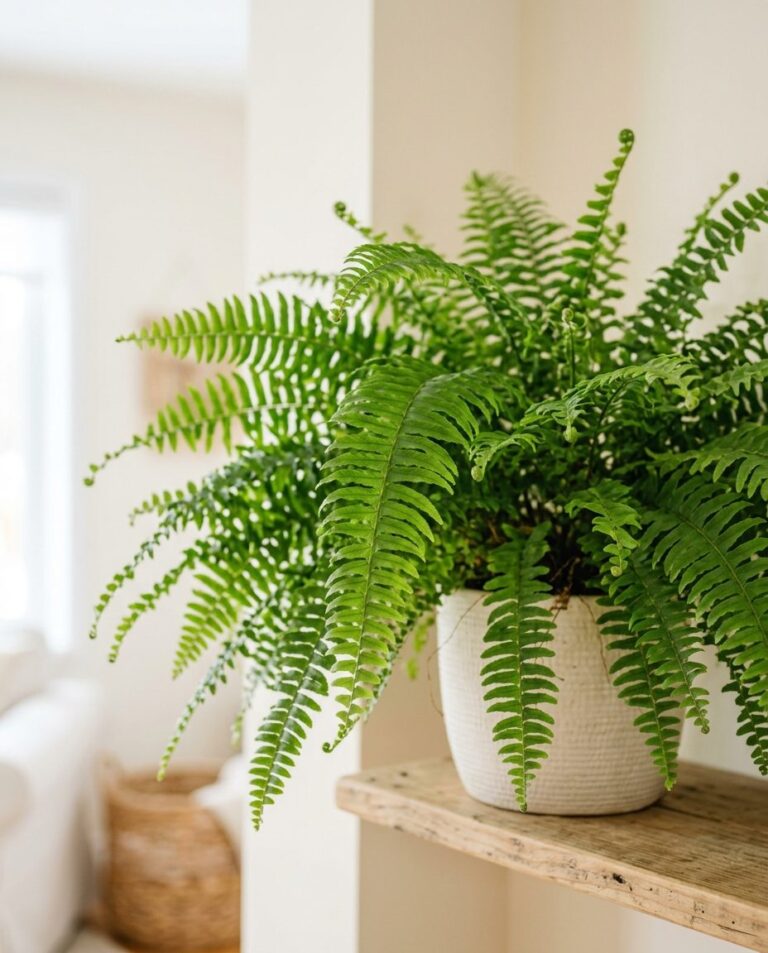
Calendar-based watering schedules-“water every Monday”-fail for Boston Ferns because evapotranspiration rates fluctuate with indoor temperature, humidity, and air circulation. Instead, insert a soil moisture sensor (analog or digital) 5 cm deep into the root zone and water when the reading drops to 3-4 on a 1-10 scale (where 1 = bone dry, 10 = saturated). In practice, this means checking the sensor every 2-3 days: during a humid Vancouver summer (zone 8b), the interval may stretch to 4 days; during a dry Calgary winter (zone 4a) with forced-air heat, you may water every 36 hours. The shallow root ball of Nephrolepis exaltata dries from the top down, so surface dryness appears 12-24 hours before the root zone becomes critically dry. Growers in Moncton (zone 6a) report that waiting until fronds wilt causes permanent pinna damage-browning that does not reverse even after rehydration.
Watering Technique to Prevent Waterlogging
Water Boston Ferns thoroughly until liquid drains from pot holes, then discard runoff immediately. The shallow root system absorbs water within 15-20 minutes; any standing water in the saucer beyond that window saturates the lower soil layer, creating anaerobic conditions that foster root rot pathogens like Pythium and Phytophthora. In Charlottetown (zone 6b), where tap water is hard (high calcium and magnesium), flush the soil monthly with distilled or rainwater to prevent mineral buildup on pinnae tips, which mimics drought-stress browning. Avoid misting fronds as a substitute for watering the root zone: misting raises humidity temporarily but delivers negligible moisture to roots and can promote fungal spores on wet pinnae surfaces in poorly ventilated rooms.
Adjusting Frequency by Season
In Ontario (zone 5b), Boston Fern water demand peaks in June-August when daylight exceeds 15 hours and indoor temperatures reach 24-26°C; expect to water every 2 days during this period. From November to February, shorter days (9 hours) and cooler indoor temperatures (18-20°C) slow transpiration, extending the interval to 4-5 days. However, if you run a humidifier to maintain 60% humidity in winter, the fern’s stomata close less frequently, sustaining higher transpiration and requiring watering every 3 days despite the season. Always trust the soil moisture sensor reading over seasonal averages.
Humidity as the Critical Success Factor: Why Boston Ferns Fail in Dry Air Unlike Pothos or Snake Plants
The single most common cause of Boston Fern decline in Canadian homes is low relative humidity. While Pothos (with waxy cuticles) and Snake Plant (with succulent leaves storing water) tolerate 30-40% humidity indefinitely, Nephrolepis exaltata requires a minimum of 50% to prevent chronic frond-tip browning and pinna desiccation. Measure ambient humidity with a digital hygrometer placed at plant height: in Regina (zone 3b) during January, indoor readings often fall to 20-25% due to continuous furnace operation. At this level, Boston Fern fronds lose turgor within 72 hours, and pinnae edges curl and brown irreversibly. Raise humidity to the 50-60% range using one or more of these methods: run a cool-mist humidifier within 1 metre of the fern (refill daily to maintain output), group multiple ferns and other humidity-loving plants (Calathea, Maranta) together to create a microclimate, or place the pot on a pebble tray filled with water (ensure the pot base sits above water level to avoid root rot). In Fredericton (zone 5b), growers report that bathroom placement near a shower provides passive humidity spikes twice daily, sufficient to keep fronds lush without additional equipment.
Humidity Thresholds and Frond Health
- Below 40%: Frond tips brown within 5-7 days; pinnae edges curl upward; new fronds emerge stunted with fewer pinnae.
- 40-50%: Marginal survival; older fronds gradually brown from tips inward; growth slows but does not halt.
- 50-60%: Minimum for sustained health; fronds remain green to the tip; new growth matches mature frond size.
- 60-75%: Optimal range; fronds achieve maximum length (90-120 cm); pinnae are dense and vibrant; minimal tip browning even in winter.
- Above 75%: Risk of fungal issues (botrytis, sooty mould) if air circulation is poor; ensure a small fan provides gentle airflow.
Humidifier Selection for Canadian Climates
Cool-mist ultrasonic humidifiers are widely available at Canadian Tire, Home Depot, and specialty retailers across all provinces. Choose a model with a 4-6 litre tank capacity to sustain 12-16 hours of output without refilling. Position the humidifier 60-100 cm from the fern crown to avoid direct mist contact, which can leave mineral deposits on pinnae if you use tap water. In Yellowknife (zone 0), where winter indoor humidity can drop below 15%, a single humidifier may be insufficient for multiple plants; consider a whole-room evaporative humidifier (5-10 litre capacity) or install a furnace-mounted humidifier to raise baseline humidity throughout your home.
Substrate Recipe Mimicking Tropical Epiphytic Origins: Ratios and Drainage Requirements
Boston Ferns thrive in a substrate that replicates the loose, organic-rich debris found in tropical forest crevices: high in sphagnum moss and bark for moisture retention, yet aerated enough to prevent waterlogging. A proven recipe for Canadian growers blends 50% peat-based potting mix (or coco coir as a sustainable alternative), 30% perlite, and 20% orchid bark (pine or fir, 1-2 cm chunks). This ratio retains moisture for 2-3 days in typical indoor conditions while allowing excess water to drain within seconds, preventing the anaerobic pockets that trigger root rot. Retailers in Quebec and Ontario stock these components year-round: look for Premier Tech or Fafard peat mixes, Vigoro or Miracle-Gro perlite, and rePotme or Better-Gro orchid bark. In Winnipeg (zone 3b), where tap water pH often exceeds 7.5, add 10% sphagnum peat moss to lower substrate pH toward the 5.5-6.5 range preferred by Nephrolepis exaltata. Avoid heavy garden soil or compost, which compact in containers and suffocate the shallow root system.
Mixing and Sterilizing Substrate
Combine components in a large tub or bucket, moisten lightly with water, and mix thoroughly until colour and texture are uniform. To sterilize the mix and eliminate fungus gnat larvae or weed seeds, spread it 5 cm deep in a metal baking tray, cover with foil, and bake at 85°C for 30 minutes (monitor with an oven thermometer). Allow the substrate to cool completely before potting. In Victoria (zone 9a), where outdoor humidity is high year-round, growers report that unsterilized bark can harbour scale insect eggs; baking eliminates this risk.
Repotting Frequency and Root Inspection
Repot Boston Ferns every 18-24 months in spring (April-May across most of Canada) when new fronds emerge. Gently remove the root ball from its pot and inspect for circling roots or black, mushy sections indicating rot. Trim damaged roots with sterilized pruning shears, then replant in fresh substrate in a pot 5 cm wider than the previous one. Avoid jumping to a much larger pot: excess soil volume stays wet too long, increasing rot risk. In Thunder Bay (zone 3a), where the growing season is short, repot no later than mid-May to give the fern a full summer to establish in the new substrate before winter dormancy.
Propagation by Division: Timing and Technique for Multiplying Mature Specimens
Boston Ferns propagate vegetatively through rhizome division, not from individual fronds or stem cuttings. The plant’s crown consists of multiple growing points connected by short rhizomes; when mature (3+ years old, pot diameter ≥25 cm), you can divide the crown into 2-4 sections, each with its own root cluster and fronds. Optimal timing is early spring (late March to early May in zones 4-6) when new fronds begin unfurling and the plant enters active growth. In Vancouver (zone 8b), division can extend into June, but avoid summer division in hotter regions like Kelowna (zone 6a), where heat stress compounds transplant shock. Never divide during fall or winter: the plant’s metabolism slows, and severed roots struggle to regenerate in cool, short-day conditions.
Step-by-Step Division Protocol
- Water the fern thoroughly 24 hours before division to hydrate roots and reduce transplant shock.
- Remove the plant from its pot and shake off loose substrate to expose the root ball and rhizomes.
- Identify natural divisions in the crown: look for gaps or weak points where rhizomes connect. Avoid forcing divisions through the centre of dense root clusters.
- Use a sterilized knife or pruning shears to cut through rhizomes, ensuring each division retains at least 3-5 fronds and a fist-sized root mass.
- Pot each division immediately in the substrate recipe above (50% peat mix, 30% perlite, 20% bark) in a pot that accommodates the root mass with 2-3 cm clearance on all sides.
- Water thoroughly, place in 200-300 foot-candles of indirect light, and maintain 60-70% humidity for the first two weeks to encourage root regeneration.
In Montreal (zone 5b), growers report that divisions produce new fronds within 3-4 weeks if kept at 20-22°C and watered when the soil moisture sensor reads 4. Expect some older fronds to yellow and drop during the first month-this is normal as the plant reallocates energy to root growth.
Propagation Failures and Troubleshooting
If a division wilts severely within 48 hours despite adequate watering, the root mass was likely too small or damaged. Salvage attempts include trimming all fronds to 10 cm length to reduce transpiration demand, enclosing the pot in a clear plastic bag to create a humidity tent (remove for 15 minutes daily to prevent mould), and moving to a cooler location (16-18°C) to slow metabolism. In Edmonton (zone 4a), where spring indoor air is dry, divisions benefit from a pebble tray and twice-daily misting until new fronds emerge.
Pest and Disease Patterns Specific to Indoor Boston Ferns: Scale, Mealybug, and Root Rot Prevention
Indoor Boston Ferns face three primary pest threats-scale insects, mealybugs, and fungus gnats-plus one major disease, root rot caused by waterlogged substrate. Scale insects (Coccoidea family) appear as small brown or tan bumps on frond undersides and rachis; they pierce pinnae to feed on sap, causing yellow spots and frond dieback. Mealybugs (Pseudococcidae) cluster in crown crevices and leaf axils, secreting white cottony wax that traps moisture and encourages sooty mould. Fungus gnats (Bradysia species) lay eggs in moist substrate; larvae feed on organic matter and fine roots, weakening the plant. Root rot manifests as black, mushy roots and wilting fronds despite wet soil, caused by Pythium or Phytophthora pathogens thriving in anaerobic conditions. Across Ontario (zone 5b) and Quebec (zone 4b), growers report scale and mealybug infestations peak in late winter (January-March) when indoor heating reduces humidity and stresses plants, making them more susceptible to pests.
Scale Insect Identification and Control
Inspect frond undersides and rachis weekly with a magnifying glass. Scale insects are immobile once mature, resembling tiny tortoise shells (2-4 mm diameter). Early detection is critical: scrape off visible scales with a fingernail or soft toothbrush dipped in rubbing alcohol. For larger infestations, spray fronds with insecticidal soap (Safer’s brand, available at Canadian Tire) or neem oil diluted to 2% concentration, repeating every 5-7 days for three weeks to target newly hatched crawlers. In Calgary (zone 4a), where tap water is hard, rinse fronds with distilled water 24 hours after treatment to prevent soap residue buildup.
Mealybug Detection and Eradication
Check the fern crown and frond axils monthly for white cottony clusters. Mealybugs hide in tight spaces and reproduce rapidly; a single female lays 300-600 eggs. Dab visible bugs with a cotton swab soaked in 70% isopropyl alcohol to kill on contact, then spray the entire plant with neem oil or insecticidal soap as above. Quarantine infested ferns away from other houseplants for at least four weeks. In Saskatoon (zone 3a), where winter indoor air is very dry, mealybugs spread faster; inspect new plants from nurseries before bringing them home, and isolate for two weeks as a precaution.
Root Rot Prevention and Recovery
Prevent root rot by ensuring the substrate drains within 5-10 seconds when watered and the pot has multiple drainage holes. If fronds wilt despite wet soil, unpot the fern immediately and inspect roots: healthy roots are white or tan and firm; rotted roots are black, slimy, and emit a foul odour. Trim all rotted sections with sterilized shears, rinse the remaining root ball under lukewarm water, and repot in fresh, dry substrate. Water sparingly for the first week (only when the soil moisture sensor reads 2-3) to allow cut roots to callus. In Halifax (zone 6b), where basements are cool and humid, use terracotta pots to wick excess moisture and reduce rot risk.
Cultivar Selection and Performance Differences Across Nephrolepis exaltata Varieties
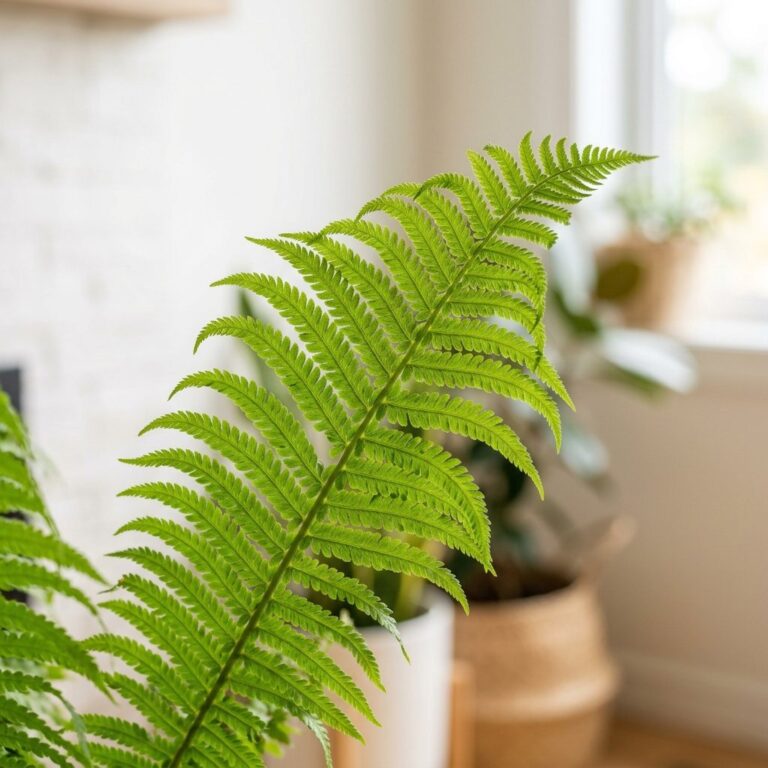
The species Nephrolepis exaltata has spawned dozens of cultivars selected for frond morphology, compactness, and cold tolerance. The original wild type, often labelled simply “Boston Fern,” produces arching fronds 60-90 cm long with evenly spaced pinnae. ‘Bostoniensis’, the classic cultivar introduced in the 1890s, is the most widely available across Canadian garden centres and features slightly broader pinnae and more vigorous growth than the wild type. ‘Compacta’ (also sold as ‘Dwarf Boston Fern’) reaches only 30-40 cm height with tightly packed fronds, ideal for small apartments in Toronto (zone 6a) or tabletop displays. ‘Fluffy Ruffles’ exhibits deeply ruffled pinnae that create a lacy, dense appearance; it tolerates slightly lower humidity (45-50%) than other cultivars, making it a better choice for drier Prairie homes in Alberta (zone 3-4). ‘Dallas’ is a heat-tolerant cultivar bred for southern U.S. climates but performs well in warm Canadian rooms (24-26°C) with stable humidity. ‘Massii’ produces narrow, delicate fronds with finely divided pinnae, resembling lace; it is more sensitive to low humidity and best suited to bathrooms or humidified rooms in Victoria (zone 9a) or Vancouver (zone 8b).
Cultivar Availability in Canada
Most Canadian nurseries stock ‘Bostoniensis’ and ‘Compacta’ year-round; specialty cultivars like ‘Fluffy Ruffles’ and ‘Massii’ appear seasonally (March-June) at independent garden centres in major cities (Montreal, Ottawa, Calgary, Vancouver). Online retailers such as Plantsome.ca and CanadianPlants.ca ship cultivars nationwide, though availability fluctuates. In Newfoundland (zone 6a), where local nurseries are limited, online ordering is the primary source for cultivar diversity.
Performance Comparison by Cultivar
- ‘Bostoniensis’: Fastest growth, longest fronds (90-120 cm), requires 55-65% humidity, best for hanging baskets.
- ‘Compacta’: Slowest growth, fronds 30-40 cm, tolerates 50-60% humidity, ideal for desks or shelves.
- ‘Fluffy Ruffles’: Moderate growth, fronds 50-70 cm, ruffled pinnae, tolerates 45-55% humidity, good for drier climates.
- ‘Dallas’: Moderate growth, fronds 60-80 cm, heat-tolerant (up to 28°C), requires 55-65% humidity.
- ‘Massii’: Slow growth, fronds 40-60 cm, delicate lacy pinnae, requires 60-70% humidity, prone to tip browning in dry air.
Diagnosing Frond Browning, Yellowing, and Wilting: Physiological Causes and Remediation
Boston Fern symptoms map directly to specific environmental stressors or care errors. Frond-tip browning-the most common complaint-results from low humidity (below 50%), salt buildup from tap water, or underwatering. Yellowing fronds indicate overwatering, root rot, or nitrogen deficiency. Wilting despite wet soil signals root rot or severe root damage. Sparse, thin fronds point to insufficient light (below 200 foot-candles) or root-bound conditions. Frond drop (entire fronds turning brown and detaching) occurs during transplant shock, sudden temperature drops, or pest infestations. Use the diagnostic flowchart below to pinpoint the cause and apply the correct remedy.
Diagnostic Flowchart for Common Symptoms
- Symptom: Frond tips brown, rest of frond green
- Check humidity: if below 50%, add humidifier or pebble tray.
- Check watering: if soil moisture sensor reads below 3, increase watering frequency.
- Check water quality: if tap water TDS exceeds 300 ppm, switch to distilled or rainwater.
- Symptom: Entire fronds yellow, starting from base
- Check soil moisture: if sensor reads above 7 for more than 3 days, reduce watering and improve drainage.
- Inspect roots: if black or mushy, trim rot and repot in fresh substrate.
- Check fertilizer: if not fed in 6+ months, apply dilute liquid fertilizer (10-10-10 at half strength).
- Symptom: Fronds wilt despite wet soil
- Unpot and inspect roots: if rotted, follow root rot recovery protocol above.
- Check pot drainage: ensure multiple holes and no blockages.
- Symptom: New fronds sparse, thin, pale
- Measure light: if below 200 foot-candles, move closer to window or add grow light.
- Check pot size: if roots circle the pot edge, repot into a container 5 cm wider.
- Symptom: Sudden frond drop (multiple fronds brown and detach)
- Check temperature: if below 15°C or above 28°C, move to stable 18-24°C location.
- Check for pests: inspect for scale or mealybugs and treat as above.
- Check recent changes: if repotted or moved within the last 2 weeks, provide extra humidity and reduce light to 150-250 foot-candles during recovery.
Remediation Priorities
Address humidity first: raising relative humidity from 35% to 55% resolves frond-tip browning within 7-10 days and prevents further damage. Second, verify light intensity: moving a fern from 100 to 300 foot-candles restores frond density within one growth cycle (6-8 weeks). Third, adjust watering based on soil moisture sensor readings rather than fixed schedules. Fourth, inspect for pests monthly and treat immediately upon detection. In Winnipeg (zone 3b), where winter conditions stress ferns most, prioritize humidity and light adjustments in November before heating season peaks.