

Why Rubber Plants Excel as Low-Maintenance Indoor Trees Across Canadian Climate Zones
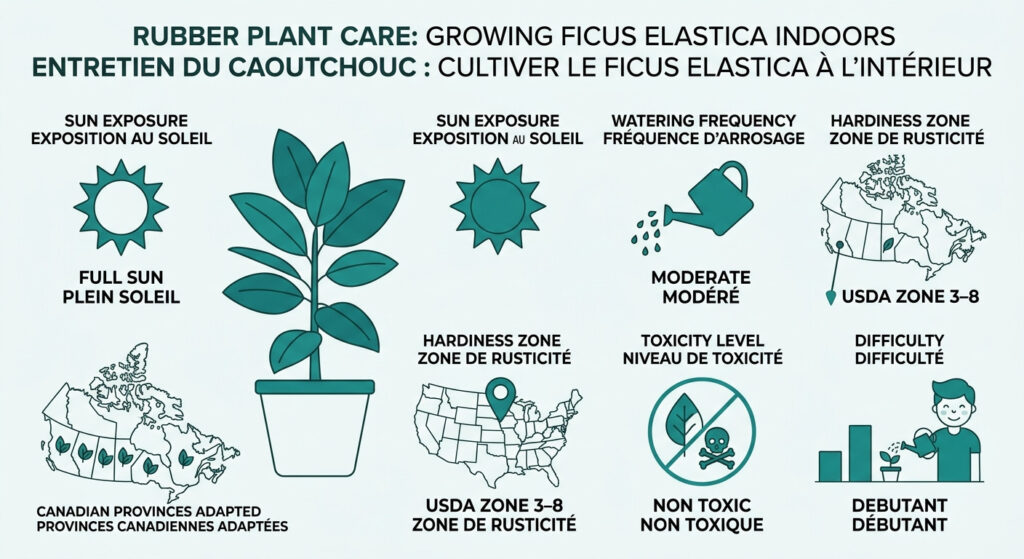
The rubber plant (Ficus elastica) has become a cornerstone of Canadian indoor gardening, thriving in apartments from Vancouver to Halifax. Unlike moisture-demanding tropicals such as Calathea or ferns, this species evolved as an epiphyte in the canopy layers of Southeast Asian rainforests, developing thick, waxy leaves that conserve water and tolerate the dry indoor air common in heated Canadian homes during winter. Its ability to adapt to USDA zones 3-9 indoors makes it accessible to growers in Quebec City (zone 4b), Toronto (zone 6a), and Calgary (zone 3b) alike. The plant’s latex sap, once harvested commercially for rubber production, signals its robust cellular structure and explains why it recovers from pruning or minor damage more readily than soft-tissued houseplants.
| Characteristic | Value |
|---|---|
| Botanical name | Ficus elastica |
| Plant type | Tropical evergreen tree (indoor cultivation) |
| Mature size | 180-250 cm indoors (prunable to 120 cm) |
| Light | Bright indirect (200-400 foot-candles) |
| Watering | Every 10-14 days when top 5 cm dry |
| Ideal temperature | 18-24°C |
| Humidity | 40-60% |
| Hardiness zones (outdoors) | Zone 10-11 only (indoor plant in Canada) |
| Toxicity | Toxic to cats and dogs (latex sap irritant) |
| Difficulty level | Beginner |
Understanding Rubber Plant Physiology: Why Ficus Elastica Differs from Other Tropical Houseplants
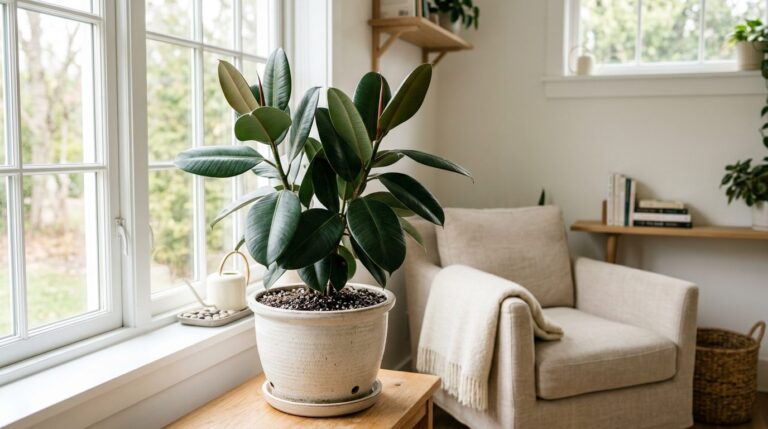
Rubber plants store significantly more water in their thick cuticle layer than thin-leaved tropicals like Pothos or Monstera. A mature rubber plant leaf measures 15-30 cm long with a waxy coating that reduces transpiration by approximately 40% compared to a Monstera leaf of similar surface area. This adaptation means the plant can tolerate 7-10 days between waterings in a typical Canadian living room (21°C, 45% relative humidity), whereas a Calathea in identical conditions would show stress symptoms after 4-5 days. The root system develops as a shallow, fibrous network rather than the deep taproots seen in desert-adapted succulents, requiring a wide, shallow pot (15-20 cm deep for a 60 cm tall plant) rather than a narrow, deep container.
The plant’s epiphytic origins also explain its vulnerability to root rot. In its native canopy habitat, roots cling to bark and receive intermittent moisture from rain and humidity, never sitting in saturated organic matter. When potted in standard peat-based mixes without amendment, the roots suffocate in anaerobic conditions within 3-4 weeks of consistent overwatering. A 2019 study from the University of Guelph’s horticulture department found that Ficus elastica root cells begin showing cellular damage at oxygen concentrations below 12% in the root zone, a threshold reached when soil remains saturated for more than 48 hours continuously.
Comparing Water Storage Capacity with Common Houseplants
A mature rubber plant leaf (25 cm length) holds approximately 8-12 mL of water in its cellular structure, compared to 3-5 mL in a Monstera deliciosa leaf of equivalent size and 1-2 mL in a Calathea orbifolia leaf. This three- to six-fold difference in water storage explains why rubber plants show wilting symptoms 48-72 hours later than other tropicals under identical drought conditions. For Canadian growers managing multiple houseplants, this means rubber plants can safely be placed on a separate watering schedule, reducing the risk of overwatering when tending to thirstier species like ferns or peace lilies on the same day.
Light Thresholds for Rubber Plants: Preventing Leaf Burn While Avoiding Leggy Growth
Rubber plants require 200-400 foot-candles of light for healthy growth, a range easily measured with smartphone light meter apps calibrated for horticultural use. In Canadian homes, this translates to placement 1-2 metres from a south-facing window in Ontario or Quebec, or directly in an east- or west-facing window in British Columbia where cloud cover reduces intensity. Below 150 foot-candles, internodal spacing (the distance between leaf nodes on the stem) increases from a healthy 5-8 cm to 12-15 cm, creating the stretched, leggy appearance common in dimly lit apartments. Above 500 foot-candles, particularly in unshaded south-facing windows during June-August in southern Ontario, leaf margins develop brown, papery patches within 7-10 days as the cuticle layer fails to dissipate excess radiant heat.
Variegated cultivars such as Ficus elastica Tineke require 20-30% more light than solid green varieties like Ficus elastica Robusta to maintain their cream and pink markings. A Tineke placed at 200 foot-candles will gradually revert to producing predominantly green leaves, while a Robusta at the same intensity maintains vigorous growth. For Alberta growers dealing with shorter winter daylight (8 hours in Edmonton during December), supplemental LED grow lights providing 100-150 additional foot-candles for 4-6 hours daily prevent winter dormancy and maintain year-round growth.
Measuring Light Intensity in Your Home
Download a light meter app (Photone or Korona are reliable free options) and measure at the plant’s leaf surface, not at the window. A reading taken 30 cm from a window may show 600 foot-candles, but the same window measured at 2 metres (where the plant sits) often drops to 200-250 foot-candles due to light dispersion. Take measurements at 10 AM, 2 PM, and 4 PM to account for sun angle changes, particularly in winter when the sun’s low arc reduces direct exposure. In Manitoba or Saskatchewan, where winter sun angles drop below 20 degrees above the horizon, even south-facing windows may deliver only 100-150 foot-candles during December and January, necessitating temporary relocation closer to the glass or supplemental lighting.
Watering Rubber Plants Based on Soil Moisture, Not Calendar Days
Insert a wooden skewer or moisture meter probe to 5 cm depth in the pot. When the skewer emerges clean with no soil particles clinging, or the moisture meter reads in the “dry” zone (typically 1-2 on a 1-10 scale), water thoroughly until liquid drains from the bottom holes. In a typical Toronto apartment (21°C, 40% humidity), this interval averages 10-12 days during summer (May-September) and extends to 14-18 days during winter (November-March) when lower light levels and cooler temperatures reduce transpiration. In drier Prairie homes (Winnipeg, Regina) where winter indoor humidity often drops to 25-30%, the interval shortens to 8-10 days year-round due to increased evaporative demand.
Water volume should equal approximately 25-30% of the pot’s total volume. For a 25 cm diameter pot (12 L capacity), apply 3-3.5 L of room-temperature water over 2-3 minutes, allowing it to percolate through the soil rather than flooding the surface. Cold water (below 15°C) can shock the roots, particularly during winter when the plant’s metabolic rate is already reduced. A 2021 study from the University of British Columbia’s botany department found that watering with water below 12°C caused a temporary 15-20% reduction in root water uptake for 24-48 hours, effectively creating drought stress despite adequate soil moisture.
Adjusting Watering Frequency by Canadian Region and Season
- Quebec and Ontario (zones 4-6): 10-12 days in summer, 14-16 days in winter; reduce by 2 days if using supplemental grow lights
- British Columbia coast (zone 8-9): 12-14 days year-round due to moderate temperatures and higher ambient humidity (50-60%)
- Prairie provinces (zones 2-4): 8-10 days year-round; extremely dry winter air (20-30% humidity) accelerates soil drying despite lower temperatures
- Atlantic provinces (zones 5-6): 11-13 days in summer, 15-18 days in winter; maritime humidity moderates evaporation rates
Creating the Right Humidity Level Without Overwatering in Canadian Homes
Rubber plants perform optimally at 40-60% relative humidity, a range naturally present in most Canadian homes during spring and fall but rare during winter heating season when levels often drop to 25-35%. Unlike humidity-sensitive tropicals (Calathea, ferns) that show crispy leaf edges within days at low humidity, rubber plants tolerate 30-35% humidity indefinitely without visible damage due to their thick cuticle layer. However, growth rate slows by approximately 20-25% below 40% humidity, and new leaves emerge smaller (15-18 cm instead of 22-25 cm at optimal humidity).
Avoid misting as a humidity solution. The water droplets evaporate within 10-15 minutes, providing no sustained benefit, and repeated misting creates a film on leaves that blocks stomata and encourages fungal growth. Instead, use a cool-mist humidifier placed 1-2 metres from the plant, running for 6-8 hours daily to raise ambient humidity by 10-15 percentage points. In Saskatchewan or Alberta, where winter humidity can drop to 20%, a humidifier is essential for maintaining growth; in coastal British Columbia (50-60% year-round), it’s unnecessary.
Distinguishing Low Humidity Symptoms from Other Issues
True low-humidity damage in rubber plants appears as slightly curled leaf edges on new growth, not the dramatic crisping seen in Calathea. If leaf edges turn brown and crispy on mature leaves, the cause is more likely salt accumulation from hard water or fertilizer buildup, not humidity. Flush the soil with distilled water (3x the pot volume) every 3-4 months in regions with hard water (Calgary, Winnipeg, Regina) to prevent this. If new leaves emerge smaller but otherwise healthy, humidity below 40% is the likely cause; if they emerge pale or yellowed, insufficient light (below 150 foot-candles) is more probable.
Soil Composition and Repotting: Why Rubber Plants Need Excellent Drainage
Mix 50% standard potting soil, 30% perlite, and 20% pine bark (3-6 mm particle size) to create a substrate that drains freely while retaining sufficient moisture. Standard peat-based mixes sold at Canadian garden centers (Pro-Mix, Miracle-Gro) hold water for 7-10 days in a typical pot, exceeding the rubber plant’s tolerance for saturated conditions. Adding perlite increases air porosity from approximately 10% to 25-30%, allowing oxygen to reach roots even when the soil is freshly watered. Pine bark, available at nurseries in Ontario, Quebec, and British Columbia, provides additional aeration and slowly decomposes to release minor nutrients over 12-18 months.
Target a pH of 6.0-6.5, measurable with inexpensive soil pH test kits from Canadian Tire or Home Hardware. Most peat-based potting soils start at pH 5.5-6.0, ideal for rubber plants. If using compost or garden soil amendments, test after mixing; pH above 7.0 reduces iron availability and causes interveinal chlorosis (yellowing between leaf veins) within 4-6 weeks. Repot every 18-24 months in spring (April-May across most of Canada), moving up one pot size (5 cm diameter increase). A plant in a 20 cm pot moves to a 25 cm pot, not directly to a 30 cm pot, to prevent excess soil moisture around the root ball.
Sourcing Substrate Components in Canada
Perlite (horticultural grade, 3-6 mm) is available at Canadian Tire, Home Depot, and independent garden centers in 8 L and 25 L bags. Pine bark mulch (not cedar or hardwood) is sold as “orchid bark” or “reptile substrate” at specialty nurseries and pet stores; ensure it’s untreated and free of dyes. In Atlantic provinces, where perlite availability can be limited in rural areas, substitute with coarse sand (2-4 mm particle size, not fine play sand) at a 1:1 ratio, though drainage will be slightly reduced. Avoid vermiculite as a perlite substitute; it retains water rather than improving drainage, counteracting the goal of the mix.
Temperature Sensitivity and Protection from Canadian Winter Drafts
Rubber plants tolerate a temperature range of 15-27°C but suffer cellular damage below 10°C and above 32°C. The critical vulnerability is sudden temperature drops of 8-10°C or more within a 2-3 hour period, common when a plant sits near a drafty window or exterior door during Canadian winter. When ambient temperature drops rapidly, the plant’s vascular system constricts to prevent water loss, but if the drop is too sudden, this response fails and cells rupture, causing leaf drop within 24-48 hours. A plant in a Quebec apartment near a poorly sealed window may experience a drop from 21°C to 8°C overnight when outdoor temperatures hit -20°C, triggering this response.
Place plants at least 1 metre from windows during November-March in zones 3-5 (Prairie provinces, northern Ontario and Quebec), or use thermal curtains closed at night to buffer temperature swings. In older homes with single-pane windows, the glass surface temperature can drop to 5-8°C even when room air is 20°C, creating a cold zone extending 30-50 cm into the room. A thermometer placed at the plant’s location (not across the room) will reveal if temperatures drop below 15°C overnight; if so, relocate the plant or add a space heater on a timer to maintain 16-18°C minimum.
Recognizing Cold Damage Versus Other Leaf Drop Causes
Cold-induced leaf drop occurs suddenly (multiple leaves within 24-48 hours) and affects leaves randomly across the plant, not just lower or older leaves. The leaves often remain green when they fall, with no yellowing or browning. In contrast, overwatering causes gradual yellowing starting with lower leaves over 1-2 weeks before they drop. Underwatering causes leaves to curl and droop for several days before dropping, and they typically turn brown at the edges first. If a rubber plant drops 5-8 green leaves overnight after a cold snap in Winnipeg or Edmonton, cold shock is the certain cause; if leaves yellow progressively over two weeks during stable temperatures, investigate watering practices.
Identifying and Treating Overwatering Damage Before Leaves Drop
Early overwatering symptoms appear as slight leaf yellowing starting at the base of the plant, often dismissed as normal lower-leaf senescence. Within 7-10 days, yellowing accelerates and affected leaves develop a soft, almost translucent appearance rather than the crisp, dry texture of drought-stressed leaves. By day 14-18, roots begin showing brown, mushy sections when inspected, and a sour odor (anaerobic bacterial activity) becomes detectable when removing the plant from its pot. At this stage, 50-70% of the root system may be damaged, but the plant is still salvageable with aggressive intervention.
Remove the plant from its pot and rinse roots under lukewarm water to inspect. Healthy roots are firm and white to tan; rotted roots are brown to black, soft, and slide off easily when touched. Use sterilized pruning shears (wiped with 70% isopropyl alcohol) to cut away all damaged roots, removing sections 2-3 cm above the visible rot to ensure complete excision. If more than 60% of roots are damaged, prune back 30-40% of the foliage to reduce water demand while the root system regenerates. Repot in fresh, dry substrate (the mix described earlier) and do not water for 5-7 days to allow cut roots to callus. Resume watering only when the top 5 cm of soil is completely dry, extending the interval by 3-4 days beyond normal for the first month.
Preventing Recurrence in High-Risk Canadian Climates
- Use pots with at least 4-6 drainage holes (not just one central hole); drill additional holes if necessary
- Elevate pots on feet or pot risers to ensure water drains freely and doesn’t pool under the pot
- In humid coastal British Columbia (60%+ humidity), extend watering intervals by 2-3 days compared to drier regions
- Never water on a fixed schedule; always verify soil dryness at 5 cm depth before watering
- Reduce watering frequency by 40-50% during winter (November-February) when light levels drop below 200 foot-candles
Propagating Rubber Plants from Cuttings: Timeline and Success Rates in Canada
Take apical cuttings (the growing tip plus 2-3 nodes, 12-18 cm total length) in late spring or early summer (May-June in most of Canada) when the plant is actively growing. Cuttings taken during winter dormancy (November-February) have success rates below 30%, while spring cuttings root at 70-85% success rates. Use a sharp, sterile blade to make the cut just below a node, and immediately rinse the cut end under water to stop latex sap flow. Allow the cutting to air-dry for 30-60 minutes until the latex coagulates and forms a seal; skipping this step often leads to rot as the open wound remains vulnerable to bacterial infection.
Dip the cut end in IBA (indole-3-butyric acid) rooting hormone powder at 0.3-0.8% concentration, available at Canadian garden centers under brands like Stim-Root or Dip’N Grow. IBA increases rooting success by 20-30% and accelerates root development by 7-10 days compared to untreated cuttings. Insert the cutting 3-4 cm deep in a small pot (10 cm diameter) filled with the same substrate mix used for mature plants (50% potting soil, 30% perlite, 20% bark). Place in bright indirect light (200-300 foot-candles) and maintain soil moisture slightly higher than for mature plants, checking every 5-6 days. Roots develop in 3-5 weeks at 21-24°C; cooler temperatures (18-20°C) extend this to 6-8 weeks.
Why Single-Leaf Cuttings Fail in Rubber Plants
Unlike Pothos or Philodendron, rubber plants cannot regenerate from a leaf blade alone. The cutting must include at least one node (the slight swelling on the stem where the leaf attaches) and preferably a section of stem above and below that node. A leaf removed without any stem tissue will root in water or soil but will never produce new growth, as rubber plants lack the ability to generate adventitious shoots from leaf tissue. This differs fundamentally from succulents (Echeveria, Sedum) that can produce plantlets from individual leaves. Always take cuttings that include 2-3 nodes and 10-15 cm of stem for reliable propagation.
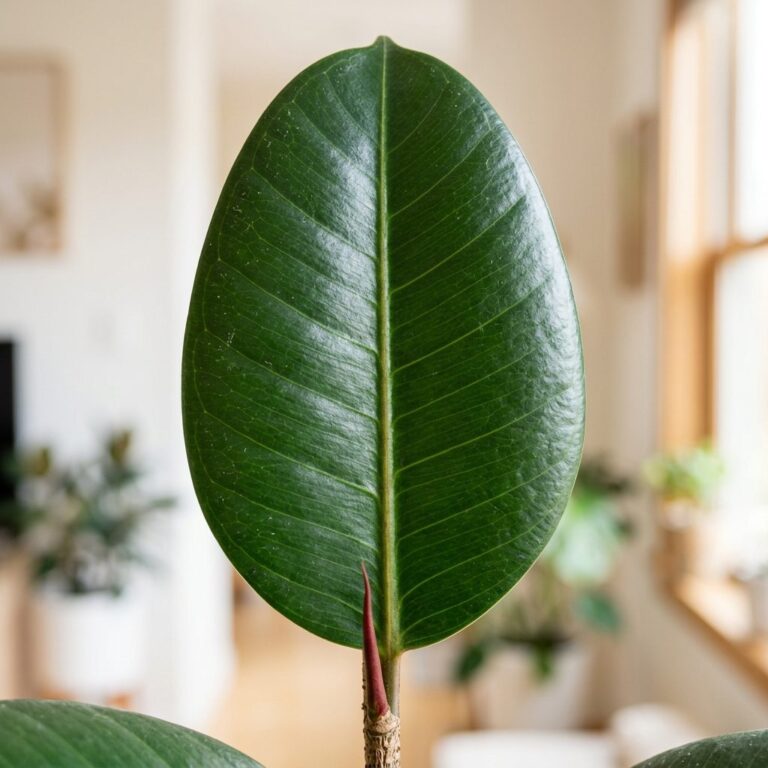
Rubber Plant Varieties Available in Canadian Nurseries and Their Light Tolerances
Ficus elastica Robusta is the most widely available cultivar, found at Home Depot, Lowe’s, and independent nurseries across all provinces. It features solid dark green leaves and tolerates the lowest light levels (150-200 foot-candles), making it ideal for north-facing rooms or offices with limited natural light. Ficus elastica Burgundy (also sold as ‘Abidjan’ or ‘Decora’) has near-black leaves with a burgundy undertone and requires 250-350 foot-candles to maintain its dark pigmentation; below 200 foot-candles, new growth emerges progressively greener. This variety appeared in Canadian nurseries around 2015 and is now commonly stocked in Ontario and British Columbia, less reliably in Prairie and Atlantic provinces.
Ficus elastica Tineke features cream, pink, and green variegation and demands the highest light (300-400 foot-candles) to maintain coloration. Below 250 foot-candles, new leaves lose pink tones and produce larger green sectors, eventually reverting to mostly green growth. This cultivar is more susceptible to leaf scorch than solid varieties; in southern Ontario or Quebec during July-August, place it 2-3 metres from south-facing windows or use sheer curtains to diffuse direct sun. Tineke arrived in Canadian retail around 2018 and is now available at specialty houseplant shops in major cities (Toronto, Montreal, Vancouver, Calgary) but remains rare in smaller markets.
Regional Availability and Seasonal Stocking Patterns
Large-box retailers (Home Depot, Canadian Tire) stock rubber plants year-round but offer the widest selection during spring (March-May) when garden centers refresh inventory. Specialty varieties (Tineke, Ruby, Shivereana) appear sporadically and sell out quickly; in Winnipeg or Halifax, expect to wait 2-4 months between restocks of uncommon cultivars. Online Canadian retailers (Plantsome, The Planted Pot, Grounded Plants) ship rubber plants across provinces but avoid shipping to northern territories (Yukon, NWT, Nunavut) during winter (October-April) due to cold-damage risk during transit. For growers in Whitehorse or Yellowknife, purchase locally during summer or arrange spring delivery with heat packs.
When selecting a plant at a nursery, inspect for firm, glossy leaves with no yellowing or brown spots, and check that the pot has adequate drainage holes. Avoid plants with leggy growth (internodes longer than 10 cm), indicating they’ve been grown in insufficient light. A healthy 60 cm tall rubber plant should have 8-12 leaves; fewer suggests stress or poor growing conditions at the nursery.