

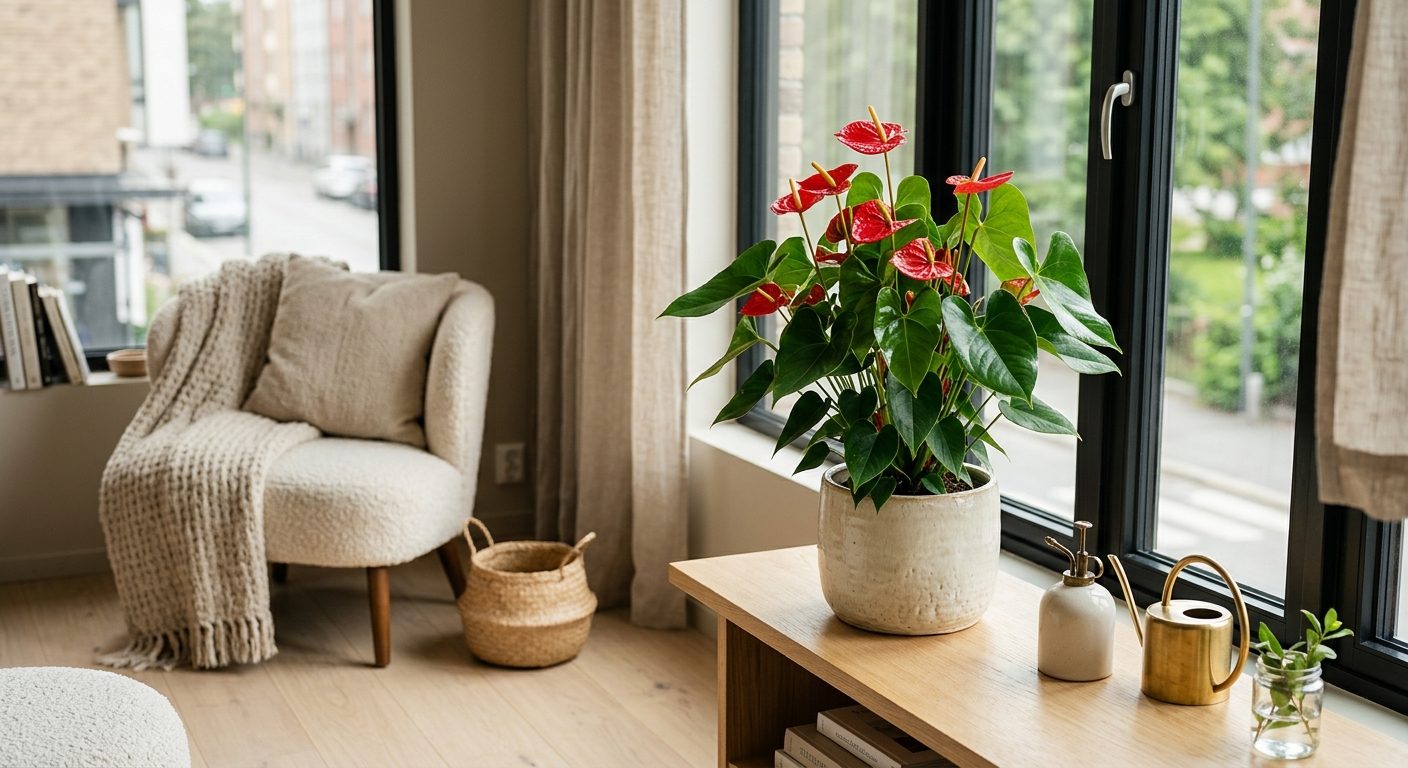
Understanding Anthurium: A Rainforest Epiphyte Adapted to Canadian Homes
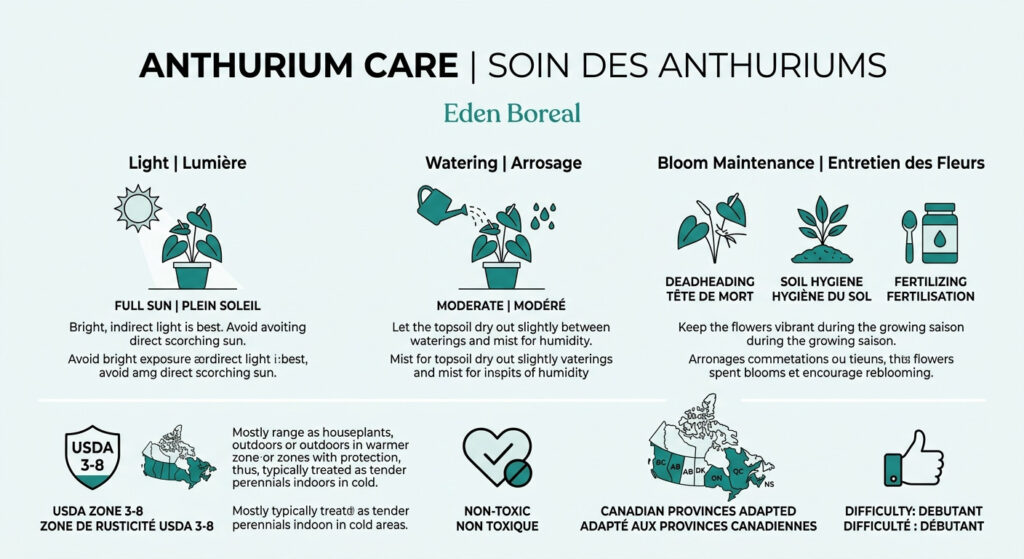
The Anthurium, native to the humid understory of Central and South American rainforests, has become a staple in Canadian living rooms from Montreal to Vancouver. Unlike many tropical houseplants that tolerate neglect, Anthurium andraeanum and Anthurium clarinervium demand precise conditions that mirror their epiphytic origins: coarse substrates that drain within seconds, consistent moisture without waterlogging, and light intensities that replicate dappled canopy shade. In zone 4 Quebec or zone 6 Ontario, where winter indoor air drops below 30% relative humidity, mimicking these parameters requires deliberate intervention. The species’ shallow root system, evolved to anchor onto tree bark rather than penetrate soil, makes it uniquely vulnerable to both drought stress and root rot, a dual sensitivity that confounds growers accustomed to forgiving pothos or philodendrons.
| Characteristic | Value |
|---|---|
| Botanical name | Anthurium andraeanum |
| Plant type | Tropical epiphytic perennial |
| Mature size | 40-60 cm height, 30-45 cm spread |
| Light | Bright filtered light, 200-400 foot-candles |
| Watering | Every 5-7 days when top 3 cm of substrate dries |
| Ideal temperature | 18-27°C |
| Humidity | 60-80% |
| Hardiness zones (outdoors) | Zone 11-12 (indoor cultivation only in Canada) |
| Toxicity | Yes, toxic to dogs and cats (calcium oxalate crystals) |
| Difficulty level | Intermediate |
Why Anthuriums Differ from Other Tropical Houseplants: Understory Physiology and Bloom Mechanics
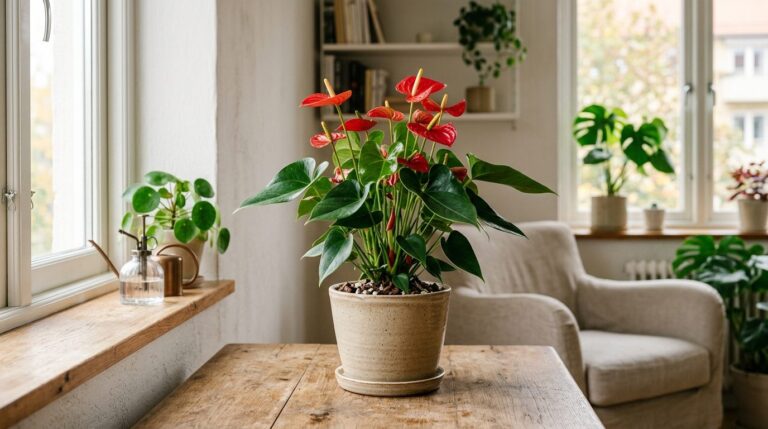
Anthuriums occupy a distinct ecological niche that separates them from the broad category of “tropical houseplants.” While plants like Monstera deliciosa or Epipremnum aureum evolved as aggressive climbers with robust aerial roots capable of extracting moisture from humid air, Anthurium species function as semi-epiphytes: their roots cling to bark crevices where decomposing organic matter accumulates in thin layers. This shallow root architecture, rarely exceeding 15 cm depth even in mature specimens, means the plant cannot buffer against prolonged drought by accessing deeper moisture reserves. In a British Columbia apartment heated to 22°C during winter, the substrate surface dries within 48 hours, yet the root zone two centimetres below may remain saturated for days, creating the paradox of simultaneous dehydration stress in upper roots and oxygen starvation in lower roots.
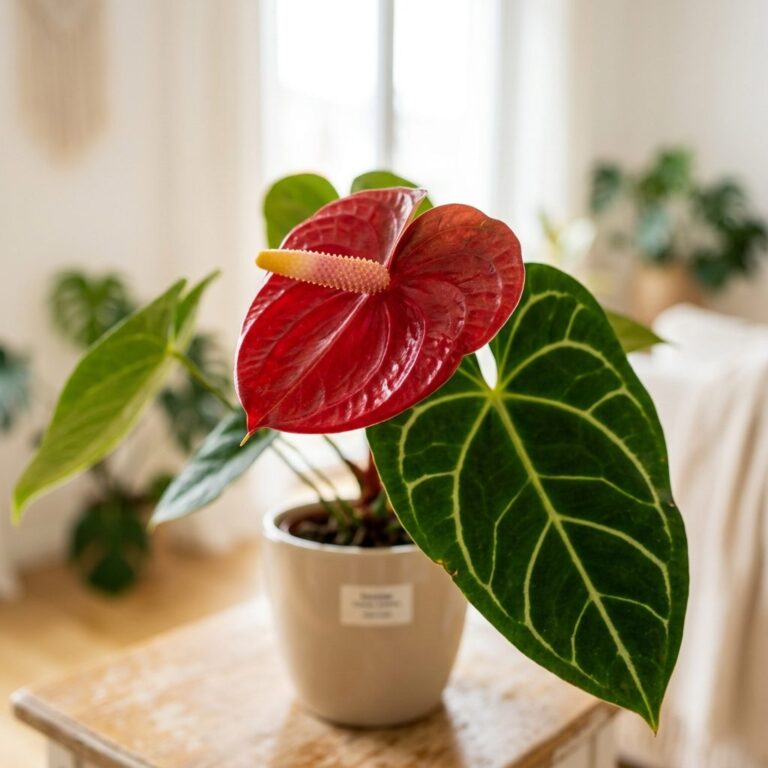
The inflorescence structure further distinguishes Anthuriums. What gardeners call the “flower” is actually a modified leaf bract (the glossy red, pink, or white spathe) surrounding a cylindrical spadix bearing hundreds of tiny true flowers. This bract remains photosynthetically active throughout its 6-12 week display period, requiring consistent phosphorus availability to maintain pigment intensity. When bracts fade from red to green, the shift signals either nutrient depletion or the plant’s reallocation of resources toward seed production on the spadix. Commercial growers in the Netherlands achieve year-round blooming by maintaining substrate EC (electrical conductivity) between 1.2-1.8 mS/cm, a precision rarely matched in home cultivation but achievable through bi-weekly dilute fertilization.
Epiphytic Root Adaptations and Substrate Implications
The velamen layer, a spongy tissue covering Anthurium roots, absorbs water rapidly during rain events in the wild but collapses when submerged continuously. This adaptation, shared with orchids, explains why Anthuriums in standard potting soil develop root rot within weeks despite moderate watering. Roots require air circulation between watering events, a condition met in nature when rainwater drains instantly through bark fissures. In Ontario homes, replicating this environment demands substrates with 40-50% air porosity even when saturated, achievable only through coarse components like orchid bark, perlite, and horticultural charcoal.
Light Thresholds for Anthurium Flowering: Beyond ‘Bright Indirect Light’
The phrase “bright indirect light” provides no actionable threshold for growers attempting to trigger or sustain Anthurium blooms. Research from the University of Florida quantifies the requirement: 200-400 foot-candles (2,150-4,300 lux) measured at leaf surface for 10-12 hours daily. Below 150 foot-candles, vegetative growth continues but bract initiation ceases; above 500 foot-candles, leaf margins develop brown necrotic patches within weeks. A north-facing window in Calgary during December provides approximately 50-100 foot-candles at midday, insufficient even for foliage maintenance. East or west windows deliver 300-600 foot-candles depending on season and obstructions, placing them in the viable range with caveats.
Measuring light intensity requires an inexpensive lux meter (available at Canadian electronics retailers for $25-40) or smartphone apps calibrated against known standards. Position the sensor at the plant’s canopy height, not at the window glass where readings are deceptively high. In Quebec apartments with double-pane windows and exterior shading from neighbouring buildings, actual light reaching plants often measures 30-50% lower than expected. Supplemental LED grow lights rated at 3,000-4,000K colour temperature and positioned 30-45 cm above foliage can compensate, with a 12-hour photoperiod mimicking equatorial day length.
Seasonal Light Variation and Bloom Cycling in Canadian Homes
Natural light in zone 5 Manitoba varies from 15 hours of daylight in June to 8 hours in December, compressing the viable blooming window to April through September without artificial supplementation. Anthuriums exhibit facultative dormancy: they reduce metabolic activity when light drops below 150 foot-candles for consecutive weeks but resume growth immediately when conditions improve. This semi-dormant state, characterized by ceased bract production and slowed leaf emergence, is not pathological but rather an energy-conservation strategy. Growers in Edmonton or Saskatoon should anticipate a natural bloom hiatus from November through February unless providing supplemental lighting.
- Spring (March-May): Increase light exposure gradually as day length extends; resume bi-weekly fertilization.
- Summer (June-August): Peak blooming period; monitor for sunburn if plants are near unshaded south windows.
- Fall (September-November): Reduce fertilizer frequency to monthly as light intensity declines.
- Winter (December-February): Accept dormancy or maintain 200+ foot-candles with grow lights to sustain year-round blooming.
Watering Frequency Adjusted for Anthurium’s Shallow Root System and Aversion to Standing Water
Anthuriums require a watering cadence calibrated to substrate surface dryness rather than calendar intervals. The top 3 cm of substrate should dry completely between waterings, a condition verifiable by inserting a finger or wooden skewer into the pot. In a heated Toronto apartment at 21°C with 35% relative humidity, this drying cycle completes in 5-6 days during winter; in a Vancouver home at 18°C with 55% humidity, the interval extends to 8-10 days. Watering before the surface dries traps carbon dioxide in the root zone, inhibiting aerobic respiration and triggering Pythium or Phytophthora root rot within 2-3 weeks.
When watering, saturate the substrate until water streams from drainage holes, then discard runoff immediately. Allowing pots to sit in saucers of water, even for 30 minutes, re-saturates the lowest substrate layer and suffocates roots. The velamen tissue absorbs its capacity within seconds; prolonged submersion provides no additional benefit and considerable harm. For growers in Alberta using municipal water with total dissolved solids (TDS) above 300 ppm, flushing the substrate monthly with distilled or rainwater prevents salt accumulation that manifests as brown leaf margins.
Diagnosing Overwatering Versus Underwatering Symptoms
Overwatering produces yellowing lower leaves that remain turgid (firm) before turning mushy, accompanied by a sour odour from the substrate. Roots, when inspected, appear brown or black and disintegrate when touched. Underwatering causes leaf tips and margins to brown and crisp while the leaf blade remains green, with roots appearing tan and firm. In zone 4 Quebec, where winter indoor humidity drops to 25-30%, underwatering symptoms often co-occur with low-humidity stress, complicating diagnosis. The distinguishing factor: underwatered plants recover turgidity within hours of watering, while overwatered specimens continue declining.
Soil Recipe Mimicking the Rainforest Epiphytic Habitat
Standard potting soil, even those labelled “tropical” or “indoor,” retains excessive moisture for Anthurium root systems. A functional substrate must drain within 5-10 seconds when saturated, leaving behind a moist but not soggy matrix. The following recipe, tested across Canadian climate zones, achieves this balance:
- 40% orchid bark (medium grade, 1-2 cm chunks)
- 30% peat moss or coco coir (moisture retention without compaction)
- 20% perlite (coarse grade, not fine powder)
- 10% horticultural charcoal (absorbs impurities, prevents anaerobic pockets)
This mix provides 45-50% air-filled porosity when saturated, replicating the aeration of bark crevices in the wild. Orchid bark, available at Canadian nurseries under brands like Miracle-Gro Orchid Mix or rePotme, decomposes over 18-24 months; annual repotting prevents substrate compaction. Avoid mixes containing vermiculite or fine sand, both of which collapse air pores and retain water in the root zone.
Sourcing Components in Canadian Garden Centres
Orchid bark and horticultural charcoal are stocked seasonally at major chains like Canadian Tire, Home Depot, and independent nurseries in Ontario and British Columbia. In rural Saskatchewan or Manitoba, online retailers such as Lee Valley Tools or Amazon.ca ship bulk quantities. Perlite sold in 8-litre bags at Rona or Lowe’s suffices for a dozen repotting projects. Growers substituting coco coir for peat moss should rinse the coir thoroughly to remove residual salts, a common issue with compressed bricks imported from tropical regions.
Temperature Stability and Humidity: Why Anthuriums Struggle in Dry Indoor Air
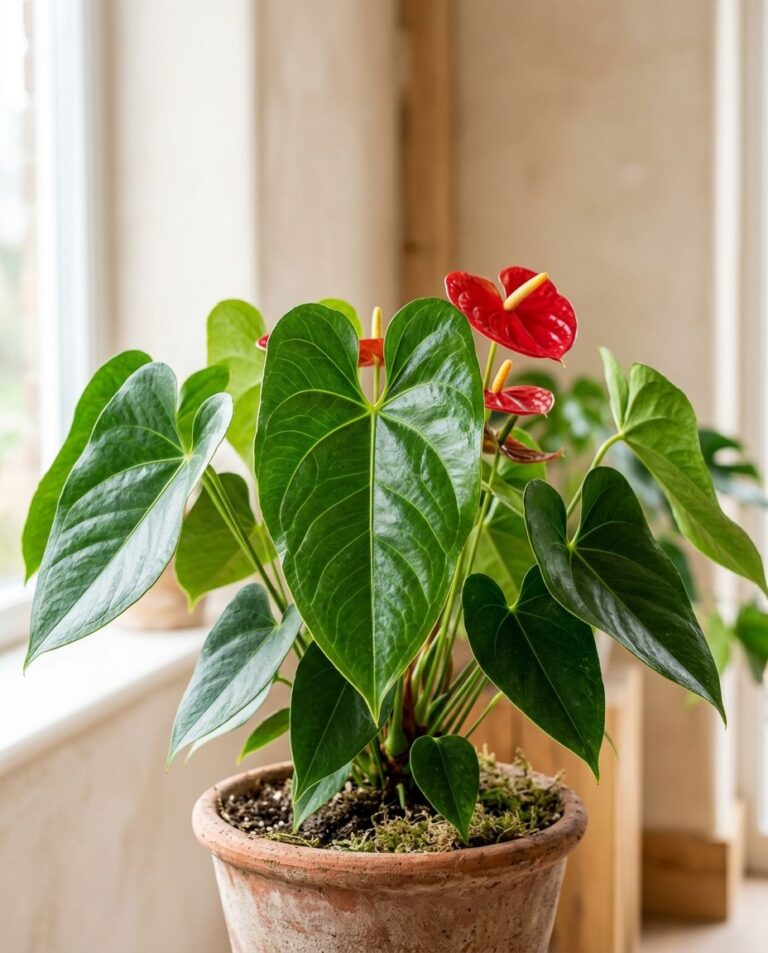
Anthuriums tolerate a temperature range of 18-27°C but suffer permanent cellular damage below 13°C or above 32°C. In zone 3 Yukon homes where indoor temperatures fluctuate between 16°C at night and 24°C during the day, the plant’s metabolic processes destabilize, manifesting as slowed growth and bract fading. More critical than temperature, however, is relative humidity. The species evolved in environments maintaining 70-90% humidity year-round; Canadian homes in winter average 25-35%, a deficit that triggers transpiration stress within days.
Brown leaf tips, the most common Anthurium complaint among Quebec and Ontario growers, result from humidity below 50% combined with inconsistent watering. The plant’s stomata, concentrated on leaf undersides, remain open to maximize gas exchange in humid conditions but cannot close rapidly enough when humidity drops. Water loss exceeds root uptake, and marginal cells desiccate. A digital hygrometer (available for $15-25 at Canadian electronics retailers) placed near the plant provides accurate readings; values below 50% require intervention.
Practical Humidity Solutions for Canadian Winters
- Pebble trays: Fill a shallow tray with gravel and water, ensuring the pot base sits above water level; evaporation raises local humidity by 5-10%.
- Room humidifiers: Ultrasonic models (e.g., Levoit or TaoTronics, $50-80 at Canadian retailers) maintain 60-70% humidity in a 15-20 m² room.
- Grouping plants: Clustering multiple tropical species creates a microclimate with 10-15% higher humidity than surrounding air.
- Bathrooms with windows: Natural humidity from showers, combined with adequate light, provides ideal conditions if temperature remains stable.
Misting foliage, a commonly recommended practice, raises humidity for only 10-15 minutes and risks fungal infections if droplets remain on leaves overnight. It is ineffective for long-term humidity management.
Fertilization Strategy to Extend Bloom Cycles Rather Than Encourage Foliage
Anthuriums require balanced NPK fertilization with slight phosphorus emphasis to sustain bract production. A 20-20-20 water-soluble fertilizer diluted to one-quarter strength (approximately 500 ppm nitrogen) applied bi-weekly during active growth (April-October in Canadian zones) maintains substrate fertility without salt accumulation. High-nitrogen formulas (e.g., 30-10-10) promote foliage at the expense of blooms, a common error among growers accustomed to feeding philodendrons or pothos.
During the dormancy period (November-February in Alberta or Saskatchewan without supplemental lighting), reduce fertilization to monthly or cease entirely. The plant’s nutrient uptake drops below 20% of peak-season rates; excess fertilizer accumulates as salt crusts on the substrate surface and pot rim. Flushing the substrate with distilled water every 6-8 weeks prevents this buildup, which otherwise causes root tip dieback and brown leaf margins.
Micronutrient Deficiencies and Bract Colour Fading
Bracts that transition from red or pink to pale green within 2-3 weeks of emergence signal either phosphorus deficiency or natural senescence. True deficiency, rare in fertilized plants, produces uniformly pale new bracts accompanied by stunted growth. More commonly, fading results from the plant diverting resources to seed production on the spadix. Removing the spadix immediately after it emerges, before pollination occurs, extends bract display duration by 4-6 weeks. This practice, standard in commercial production, is underutilized by home growers in Ontario and British Columbia.
Identifying and Treating Root Rot, Brown Leaf Tips, and Sunburn Before They Spread
Root rot, caused by Pythium or Phytophthora pathogens, is the leading cause of Anthurium mortality in Canadian homes. Early symptoms include yellowing lower leaves that remain turgid, a sour substrate odour, and slowed growth despite adequate light and temperature. Inspection reveals brown, mushy roots that slough outer tissue when touched. Immediate intervention involves unpotting the plant, removing all affected roots with sterilized shears, and repotting in fresh substrate. Drench the new substrate with a hydrogen peroxide solution (1 part 3% peroxide to 4 parts water) to oxidize residual pathogens.
Brown leaf tips, distinct from root rot, result from low humidity, fluoride toxicity, or salt accumulation. In Montreal or Toronto, where municipal water contains 0.5-1.0 ppm fluoride, sensitive Anthurium varieties develop tip necrosis within months. Switching to distilled water or rainwater halts progression. Trim affected tips with sterilized scissors, cutting into healthy tissue at a 45-degree angle to minimize visible damage.
Sunburn manifests as bleached or brown patches on leaf surfaces facing the light source, often appearing within hours of exposure to direct sun. Unlike fungal or bacterial spots, sunburn damage has sharply defined edges and does not spread. Affected leaves cannot recover pigment; remove them to improve aesthetics. Prevent recurrence by filtering light through sheer curtains or relocating plants 1-2 metres from south-facing windows in Calgary or Winnipeg.
Pest Identification: Spider Mites and Scale in Low-Humidity Conditions
Spider mites, invisible to the naked eye, thrive in dry indoor air below 40% humidity. Symptoms include fine webbing on leaf undersides, stippled yellow spots on upper surfaces, and premature leaf drop. Rinse foliage weekly with room-temperature water to dislodge mites, and raise humidity above 50% to suppress reproduction. Scale insects, appearing as brown oval bumps on stems and leaf veins, secrete honeydew that attracts sooty mould. Remove manually with a cotton swab dipped in 70% isopropyl alcohol, repeating weekly until eradicated.
Repotting Frequency and Pot Size: Why Anthuriums Resist Large Containers
Anthuriums require repotting every 12-18 months, not to provide additional root space but to refresh decomposing substrate. Orchid bark and peat moss break down over time, reducing air porosity and increasing water retention. A plant potted in April 2024 will exhibit substrate compaction by October 2025, manifesting as slower drainage and increased susceptibility to root rot. Repot in spring (March-May in Canadian zones) when the plant enters active growth and can establish roots rapidly.
Select a pot 2-3 cm larger in diameter than the current container, never more. Anthuriums, with their shallow root systems, cannot colonize large volumes of substrate; excess soil remains perpetually wet, fostering anaerobic conditions. A mature plant 50 cm tall thrives in a 15-18 cm pot indefinitely. Prioritize pot depth over width: containers 12-15 cm deep provide adequate volume without excessive substrate mass.
Step-by-Step Repotting Protocol
- Water the plant 24 hours before repotting to reduce transplant shock.
- Unpot carefully, loosening compacted roots with fingers; avoid tearing.
- Inspect roots, removing any brown or mushy sections with sterilized shears.
- Place a layer of fresh substrate in the new pot, position the plant at the same depth as previously, and fill around roots.
- Water thoroughly until runoff appears, then place in bright filtered light for 1-2 weeks to acclimate.
Avoid fertilizing for 4-6 weeks post-repotting; fresh substrate contains sufficient nutrients, and roots require time to repair minor damage incurred during the process.
Propagation Methods: Comparing Division, Stem Cuttings, and Air Layering for Viability
Division, the most reliable propagation method for Anthuriums, involves separating offsets (new plants emerging from the base) during repotting. Each division must include 3-5 leaves and an intact root system. Success rate exceeds 90% when performed in spring (April-May in Ontario or Quebec) and divisions are maintained at 21-24°C with 60-70% humidity. Pot divisions in the same substrate recipe as mature plants, using containers 8-10 cm in diameter.
Stem cuttings, taken from nodes with visible aerial roots, root in 4-6 weeks when placed in moist sphagnum moss or perlite. Cut below a node with sterilized shears, remove lower leaves, and insert the cutting 3-4 cm deep in the rooting medium. Enclose in a clear plastic bag to maintain humidity, opening daily for air exchange. Success rate approximates 60-70%, lower than division due to susceptibility to fungal rot during the rooting phase.
Air layering, though labour-intensive, achieves near 100% success for valuable or rare Anthurium varieties. Identify a stem section with aerial roots 10-15 cm below the growing tip. Wrap moist sphagnum moss around the node, encase in plastic wrap, and secure with twist ties. Roots colonize the moss within 6-8 weeks; sever the stem below the rooted section and pot as a new plant. This method, standard in commercial propagation of Anthurium clarinervium and variegated cultivars, is underutilized by home growers in British Columbia and Alberta.
Propagation Timing and Environmental Control in Canadian Climates
All propagation methods succeed best when initiated in April or May, aligning with the plant’s natural growth surge as day length and light intensity increase across Canadian zones. Attempting propagation in November or December, when the plant enters semi-dormancy, results in failure rates above 80%. Maintain propagation setups at 22-25°C and 70-80% humidity; a small heated propagation mat (available at Canadian Tire or Lee Valley for $30-50) and a clear plastic enclosure create suitable conditions in zone 4 Manitoba or zone 5 Ontario homes.
Pro tip: Anthuriums propagated via division bloom within 6-9 months, while stem cuttings require 12-18 months to reach flowering maturity. Air-layered plants, having established root systems at separation, often bloom within 3-4 months.