

Muscari: The Self-Sustaining Spring Bulb Colony for Canadian Gardens
Muscari, commonly known as grape hyacinth, represents one of the most reliable naturalization systems for Canadian gardeners seeking low-maintenance spring colour. Unlike many ornamental bulbs that decline after a few seasons, Muscari colonies expand through both bulb offsets and seed production, creating dense carpets of cobalt-blue racemes that return with increasing vigour across USDA zones 3 through 8. Native to Mediterranean and temperate Eurasian regions, these spring ephemerals have adapted remarkably well to Canadian freeze-thaw cycles, from the Laurentians of Quebec to the Okanagan Valley of British Columbia. The genus comprises approximately 40 species, with Muscari armeniacum, Muscari botryoides, and Muscari comosum dominating both commercial availability and naturalized populations. Understanding the physiological mechanisms behind Muscari’s persistence-offset production rates, foliage nutrient cycling, and seed germination patterns-transforms these bulbs from simple ornamentals into a self-managing ground cover system that requires intervention only to control spread rather than ensure survival.
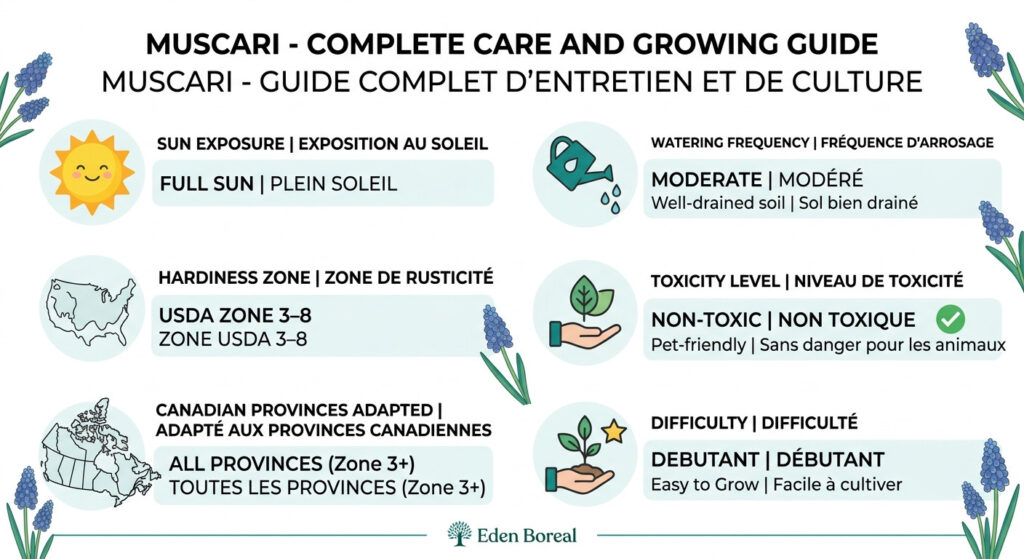
| Characteristic | Value |
|---|---|
| Botanical name | Muscari armeniacum (most common species) |
| Plant type | Spring-flowering bulb, perennial |
| Mature size | 15-25 cm height, 8-10 cm spread per bulb |
| Light | Full sun to partial shade (4-8 hours direct light) |
| Watering | Minimal after establishment; spring moisture from snowmelt sufficient |
| Ideal temperature | -40°C to 25°C (requires vernalization below 5°C for 12-14 weeks) |
| Humidity | Tolerates 30-80% relative humidity |
| Hardiness zones (outdoors) | Zone 3 to Zone 8 |
| Toxicity | Mildly toxic to cats and dogs (saponins cause gastrointestinal upset) |
| Difficulty level | Beginner |
Muscari Anatomy: Why Grape Hyacinth Flowers Cluster in Dense Spikes

The characteristic flower structure of Muscari is a raceme inflorescence-a central stem bearing 20 to 40 individual urn-shaped flowers arranged in a dense, conical spike. Each flower measures 4 to 6 mm in length, with six fused tepals forming a globular to tubular corolla that constricts at the mouth, creating the distinctive “grape” appearance. The cobalt-blue pigmentation results from delphinidin-based anthocyanins concentrated in epidermal vacuoles, with colour intensity varying by species: Muscari armeniacum displays deep indigo-blue with white rim margins, while Muscari botryoides exhibits paler sky-blue tones. Fertile flowers occupy the lower two-thirds of the raceme, while the upper third comprises sterile flowers that serve as visual attractants for early-season pollinators-primarily Bombus species (bumblebees) and Andrena mining bees active in Ontario and Quebec from late April through mid-May. The scent profile is faintly musky-sweet, detectable within 30 cm, produced by volatile monoterpenes that guide pollinators to nectar reservoirs at the base of each flower.
Raceme Development and Flowering Sequence
Flower buds initiate within the bulb during the previous growing season, typically between June and August when foliage is still photosynthetically active. The embryonic inflorescence remains dormant through summer and autumn, requiring vernalization-a cumulative exposure to temperatures below 5°C for 12 to 14 weeks-to trigger stem elongation and bud differentiation. In zone 4 regions such as Montreal and Ottawa, this requirement is reliably met by mid-March, with flowering commencing 10 to 14 days after snowmelt when soil temperatures reach 8°C at 10 cm depth. The flowering sequence proceeds acropetally (base to apex) over 7 to 10 days, with individual flowers remaining receptive for 3 to 4 days. This staggered maturation extends the pollination window and increases seed set probability in unpredictable spring weather conditions common across southern Ontario and the St. Lawrence Valley.
Foliage Emergence Timing and Cold Tolerance
Muscari foliage exhibits an unusual phenology: leaves emerge in autumn (September-October in zone 5), persist through winter as semi-dormant rosettes, then resume active growth in early spring before flowering. This autumn emergence strategy allows the bulb to capture solar energy during the extended photoperiod of late autumn and early spring, maximizing carbohydrate reserves before canopy closure of deciduous trees. The leaves are linear, 15 to 30 cm long and 3 to 6 mm wide, with a succulent texture and prominent midrib. Cold hardiness is exceptional: foliage tolerates temperatures down to -25°C without tissue damage when insulated by snow cover, a critical adaptation for survival in zone 3 regions of northern Alberta and interior British Columbia where January minimums routinely reach -30°C. This cold tolerance is mediated by high concentrations of soluble sugars (fructans) and antifreeze proteins in leaf cell vacuoles.
Planting Depth and Spacing: The Offset Multiplication Strategy
Optimal planting depth for Muscari bulbs is 8 to 10 cm from soil surface to bulb base, measured in autumn when soil temperatures drop below 15°C-typically late September in zone 4 and early October in zone 6. This depth provides sufficient insulation against freeze-thaw cycles while allowing emerging foliage to penetrate mulch and leaf litter in early spring. Spacing density directly influences colony expansion rate: initial planting at 5 cm intervals (approximately 400 bulbs per square metre) produces a visually dense display in the first spring, while 10 cm spacing (100 bulbs per square metre) allows room for offset proliferation and achieves comparable density by the third season. Each mature Muscari bulb produces 2 to 4 offsets annually under favourable conditions, with offset production rate correlated to bulb size-bulbs exceeding 2 cm diameter generate more offsets than smaller bulbs below 1.5 cm diameter.
Bulb Offset Development and Detachment Timeline
Offset formation begins in late spring as the parent bulb channels post-flowering carbohydrate reserves into lateral bud development along the basal plate. These bulblets remain attached to the parent through the first dormant season, drawing nutrients from the parent bulb’s stored reserves. By the second autumn, offsets develop independent root systems and detach naturally through basal plate degradation, establishing as autonomous bulbs capable of flowering within 2 to 3 years depending on size at separation. In rich loam soils common in the Fraser Valley of British Columbia and the Annapolis Valley of Nova Scotia, offset maturation accelerates, with first-year offsets reaching flowering size (1.5 cm diameter) within 18 months. In contrast, sandy soils with lower nutrient retention delay flowering maturity to 3 years. This multiplication dynamic means a planting of 100 bulbs in zone 5 Ontario can expand to 400 to 600 flowering units within 5 years without intervention, assuming 50% offset survival and maturation.
Planting Configuration for Controlled Naturalization
To manage Muscari expansion while maintaining aesthetic impact, deploy bulbs in discrete drifts rather than linear rows. Drifts of 25 to 50 bulbs planted in irregular ovals or kidney shapes mimic natural colonization patterns and integrate seamlessly with existing perennial plantings. Install physical barriers-polyethylene edging sunk to 15 cm depth-around drift perimeters to contain bulblet migration into adjacent beds. In zone 6 gardens of southern Ontario and coastal British Columbia, where growing seasons extend beyond 180 days, Muscari offsets can migrate up to 20 cm radially per year through soil disturbance by earthworms and freeze-thaw heaving. Edging prevents this lateral spread into lawn areas where mowing conflicts with foliage senescence requirements. For naturalization under deciduous trees-a common application in Quebec and New Brunswick-plant bulbs in concentric rings radiating from the trunk, with density decreasing outward to create a graduated colour gradient as the colony expands.
Light Requirements and Performance Under Tree Canopy
Muscari demonstrates exceptional shade tolerance compared to other spring bulbs, thriving under deciduous tree canopies where early-season light availability is high before leaf-out. Photosynthetic activity peaks during the spring ephemeral window-the 6 to 8 week period from snowmelt to canopy closure when understory light levels reach 40 to 60% of full sun. In zone 4 gardens with mature sugar maples (Acer saccharum) or red oaks (Quercus rubra), this window typically spans late March through mid-May, providing sufficient photosynthetically active radiation (PAR) for Muscari to complete flowering, seed set, and foliage nutrient resorption before canopy shade reduces light to below 10% of ambient levels. Quantitative measurements in southern Ontario indicate Muscari armeniacum achieves 85 to 90% of maximum flower production under canopies transmitting 30% full sun during the spring ephemeral period, compared to only 60% flower production for tulips and 50% for daffodils under identical conditions.
Photosynthetic Compensation and Leaf Longevity
The key to Muscari’s shade performance lies in its extended foliage period: leaves emerge in autumn and persist through winter, capturing solar energy during the low-angle sun conditions of November and March when deciduous canopies are bare. This strategy provides 4 to 5 months of photosynthetic opportunity unavailable to spring-emerging bulbs. Leaf chlorophyll concentration in Muscari is 20 to 30% higher than in Tulipa or Narcissus species, enhancing light capture efficiency under suboptimal conditions. In zone 5 gardens of Quebec’s Eastern Townships, where April cloud cover averages 60%, this chlorophyll density compensates for diffuse light conditions, maintaining net carbon gain sufficient for bulb replenishment and offset production. However, under evergreen conifers-such as white spruce (Picea glauca) or eastern hemlock (Tsuga canadensis)-where year-round shade reduces spring light to below 20% of full sun, Muscari flowering declines by 40 to 50% within 3 years, and colonies gradually thin as bulbs exhaust stored reserves without adequate photosynthetic replenishment.
Optimal Planting Sites in Canadian Landscapes
Ideal Muscari planting sites in Canadian gardens include the drip line zones of deciduous trees, south-facing slopes with sparse shrub cover, and perennial borders where early-season bare soil provides unobstructed light access. In zone 6 British Columbia, planting beneath Amelanchier (serviceberry) or Cornus (dogwood) species maximizes the spring ephemeral window, as these trees leaf out later than maples or poplars. Avoid planting under Norway maples (Acer platanoides), which leaf out 2 to 3 weeks earlier than native species and cast dense shade that truncates the photosynthetic period. In prairie regions of Alberta and Saskatchewan, where tree cover is limited, plant Muscari on the north or east sides of buildings or fences to provide afternoon shade during late May when temperatures can spike above 25°C, causing premature foliage senescence and reduced bulb replenishment.
Soil Drainage as the Critical Success Factor for Bulb Longevity
Soil drainage is the single most critical factor determining Muscari bulb longevity in Canadian gardens. Bulbs tolerate winter cold to zone 3 but are highly susceptible to basal rot caused by Fusarium oxysporum and Penicillium species when soil remains saturated for extended periods. In heavy clay soils-common across the Red River Valley of Manitoba, the Regina Plains of Saskatchewan, and parts of the Ottawa Valley-spring snowmelt and rainfall can maintain soil moisture at field capacity for 4 to 6 weeks, creating anaerobic conditions that promote fungal proliferation. Bulb rot incidence in unamended clay soils ranges from 15 to 25% annually, with cumulative losses reaching 60% over 5 years. In contrast, sandy loam or amended soils with drainage rates exceeding 2.5 cm per hour exhibit rot incidence below 5%, allowing colonies to persist and expand for decades.
Soil Amendment Protocols for Heavy Clay
To establish Muscari in heavy clay, amend planting areas to a depth of 20 cm with a mixture of 50% native soil, 30% coarse sand (2-5 mm particle size), and 20% composted pine bark fines. This ratio increases macroporosity (air-filled pore space) from 10-15% in unamended clay to 25-30% in amended soil, allowing gravitational water to drain within 24 to 48 hours after saturation. Avoid using peat moss as a drainage amendment; while it improves initial porosity, peat decomposes within 2 to 3 years and compacts, reducing long-term drainage efficacy. In zone 4 Ontario, where freeze-thaw cycles cause soil heaving, incorporate 1/4-inch crushed granite at 10% by volume to maintain pore structure through repeated freezing. For large naturalization projects-such as under-planting an entire woodland edge-consider installing French drains or subsurface drainage tiles at 30 cm depth to intercept seasonal water tables that rise during spring thaw in low-lying areas of southern Quebec and New Brunswick.
Raised Bed Construction for Marginal Sites
In sites with chronic drainage problems-such as compacted urban soils or areas with shallow bedrock-construct raised beds elevated 15 to 20 cm above grade. Fill beds with a custom mix of 40% topsoil, 40% coarse sand, and 20% composted leaf mould, creating a free-draining medium that sheds excess moisture while retaining sufficient water for spring growth. In zone 5 gardens of Toronto and Montreal, raised beds also provide earlier soil warming-soil temperatures at 10 cm depth reach 8°C (the threshold for root growth) 7 to 10 days earlier in raised beds than in grade-level plantings, advancing flowering by up to one week. Edge raised beds with untreated cedar or composite lumber to prevent soil erosion and contain bulb migration. This approach is particularly effective in boulevard plantings where road salt accumulation and soil compaction from snow removal equipment create hostile conditions for most bulbs, but Muscari’s salt tolerance (up to 2,000 ppm sodium chloride) allows survival when drainage is adequate.
Naturalization Patterns: How Muscari Self-Seeds Across Seasons
Beyond vegetative multiplication through offsets, Muscari employs seed production as a secondary colonization strategy, particularly effective in establishing populations in new microsites beyond the parent bulb cluster. Each Muscari flower produces a three-chambered capsule containing 6 to 12 seeds when successfully pollinated. Seed set rates vary by species and pollinator availability: Muscari armeniacum achieves 60 to 80% capsule formation in gardens with established bumblebee populations, while Muscari comosum-which requires longer-tongued pollinators-often exhibits seed set below 30% in Canadian gardens lacking appropriate pollinator fauna. Seeds mature 6 to 8 weeks post-flowering, with capsules dehiscing (splitting open) in late June or early July when moisture content drops below 12%. Seed dispersal is primarily barochorous (gravity-driven), with seeds falling within 10 to 30 cm of the parent plant, though secondary dispersal by ants (myrmecochory) can extend range to 2 to 3 metres.
Seed Germination Requirements and Timeline
Muscari seeds require a cold stratification period of 10 to 12 weeks at 2 to 5°C to break physiological dormancy, a requirement naturally satisfied by Canadian winter conditions. Seeds shed in July remain dormant through summer and autumn, germinating the following March or April when soil temperatures reach 8 to 10°C and moisture is abundant from snowmelt. Germination rates in undisturbed garden soil range from 40 to 60%, with seedlings producing a single grass-like cotyledon and a small bulblet (3 to 5 mm diameter) by the end of the first growing season. These seedling bulbs require 3 to 4 years to reach flowering size (1.5 cm diameter), during which they are vulnerable to desiccation, competition from perennial weeds, and predation by voles. In zone 4 Quebec, where vole populations fluctuate cyclically, seedling survival can drop to 20% during peak vole years, significantly slowing colony expansion via seed compared to offset multiplication. However, in disturbed soils-such as mulched beds or areas with annual soil cultivation-seed germination and seedling survival increase markedly, as reduced competition and exposed mineral soil favour establishment.
Long-Distance Colonization Mechanisms
While Muscari is not classified as invasive in most Canadian jurisdictions, its seed dispersal and vegetative spread can result in colonization of unintended areas, particularly in naturalized woodland gardens and municipal parks. In zone 6 British Columbia, where mild winters and extended growing seasons favour rapid bulb multiplication, Muscari armeniacum has established feral populations along roadside ditches and forest edges within 500 metres of original plantings. Elaiosome-bearing seeds (seeds with lipid-rich appendages attractive to ants) facilitate this spread: ants transport seeds to nest sites 2 to 5 metres from parent plants, where seeds are deposited in nutrient-rich middens that enhance germination success. In southern Ontario, Muscari has naturalized in deciduous woodlots managed by conservation authorities, forming extensive carpets that, while visually striking, can outcompete native spring ephemerals such as Trillium and Erythronium species for light and soil resources during the critical spring growth window.
Post-Bloom Foliage Management and Nutrient Cycling
Foliage senescence management is critical for sustained Muscari performance and colony expansion. After flowering concludes in late May or early June (depending on zone), leaves remain photosynthetically active for an additional 4 to 6 weeks, during which they export carbohydrates to the bulb for storage and offset development. Premature removal of foliage-whether by mowing, cutting, or tying into bundles-reduces bulb replenishment by 40 to 60%, resulting in smaller bulbs, fewer offsets, and diminished flowering the following spring. In zone 5 Ontario, foliage typically remains green until mid-July, then senesces naturally as chlorophyll degrades and nitrogen is resorbed into the bulb. This nutrient resorption recovers 50 to 70% of foliar nitrogen, representing a significant conservation of resources in nutrient-poor soils. Allowing foliage to senesce naturally also deposits organic matter at the soil surface, contributing to humus formation and improving soil structure over time.
Aesthetic Strategies for Declining Foliage
The visual challenge of senescing Muscari foliage-which yellows and flops as it declines-can be mitigated through companion planting strategies that camouflage dying leaves without impeding photosynthesis. Plant Muscari among later-emerging perennials such as Hosta, Astilbe, or Hemerocallis (daylilies), which produce expanding foliage in late May and June that gradually obscures the declining bulb leaves. In zone 4 Quebec, pairing Muscari with Brunnera macrophylla (Siberian bugloss) creates a successional display: Muscari flowers in April, followed by Brunnera blooms in May, with Brunnera’s large heart-shaped leaves concealing Muscari foliage by mid-June. Alternatively, interplant Muscari with low-growing groundcovers such as Ajuga reptans or Vinca minor, which provide year-round foliage cover while allowing Muscari leaves to emerge and senesce without visual conflict. Avoid planting Muscari in formal beds or high-visibility areas where declining foliage is aesthetically unacceptable, unless prepared to tolerate the 6-week senescence period.
Mowing Protocols for Naturalized Lawns
In naturalized lawn settings-where Muscari is intentionally planted in turf to create spring colour-delay mowing until foliage has fully senesced, typically mid-July in zone 4 and late June in zone 6. This requires accepting unmowed grass during the late spring period, a trade-off many homeowners find unacceptable. An alternative approach is to establish Muscari in discrete lawn islands or under trees where mowing can be deferred without affecting the broader lawn aesthetic. In zone 5 British Columbia, where mild spring temperatures promote rapid grass growth, the conflict between Muscari foliage senescence and lawn maintenance is particularly acute. One solution is to plant Muscari in conjunction with low-mow or no-mow lawn areas-sections of turf managed for biodiversity rather than manicured appearance-where delayed mowing aligns with ecological goals of supporting pollinators and native flora. Mark Muscari planting areas with discrete stakes or landscape flags to prevent accidental early mowing by maintenance crews or family members unfamiliar with bulb phenology.
Distinguishing Muscari armeniacum from Botryoides and Comosum Species
While Muscari armeniacum dominates commercial availability and naturalized populations in Canada, understanding the morphological and ecological distinctions among the three primary species-armeniacum, botryoides, and comosum-enables informed variety selection for specific landscape applications. Muscari armeniacum, native to the Caucasus and eastern Turkey, produces dense racemes of 30 to 40 deep cobalt-blue flowers with conspicuous white rim margins on each tepal. Flower spikes reach 15 to 20 cm in height, and the species exhibits the highest cold hardiness of the three, reliably flowering in zone 3 regions of northern Alberta and Saskatchewan. Offset production is prolific, with mature bulbs generating 3 to 4 offsets annually, resulting in rapid colony expansion. Foliage is semi-evergreen, emerging in September and persisting through winter, making it the most visible species during the dormant season.
Muscari Botryoides: The Compact Alternative
Muscari botryoides, native to central and southern Europe, is distinguished by its smaller stature (10 to 15 cm flower spike height) and paler blue colouration-often described as sky-blue or periwinkle. Flowers are more spherical than those of armeniacum, with less pronounced constriction at the tepal mouth, giving a rounder “grape” appearance. This species is better suited to rock gardens and alpine troughs where its compact habit integrates with low-growing alpines such as Sedum and Sempervivum. Cold hardiness is slightly reduced compared to armeniacum, with reliable performance in zones 4 through 8 but occasional winter kill in exposed zone 3 sites lacking consistent snow cover. Offset production is moderate, with bulbs generating 1 to 2 offsets per year, resulting in slower colony expansion. Muscari botryoides ‘Album’ is a white-flowered cultivar popular in southern Ontario and British Columbia for creating contrast with blue-flowered species in mixed bulb plantings.
Muscari Comosum: The Ornamental Outlier
Muscari comosum, known as tassel hyacinth or feather hyacinth, diverges significantly from the typical Muscari morphology. Flower spikes reach 25 to 35 cm and consist of two distinct zones: fertile brownish-purple flowers in the lower half and a showy tuft of sterile violet-blue flowers at the apex, creating a feathery or tasselled appearance. This species is native to Mediterranean regions and exhibits reduced cold hardiness, reliably perennial only in zones 5 through 8. In zone 4 Quebec and Ontario, Muscari comosum requires winter mulching with 10 to 15 cm of shredded leaves or straw to prevent bulb freezing. The species is less aggressive in spreading, with minimal offset production (0 to 1 per year) and lower seed set due to reliance on specialized pollinators rare in Canadian gardens. Muscari comosum ‘Plumosum’ is a fully sterile cultivar with all flowers transformed into violet filaments, creating a dense feathery spike prized for cut flower arrangements and specialty gardens in zone 6 British Columbia and sheltered zone 5 microclimates.
Invasiveness Concerns and Containment Methods

While Muscari is not listed as an invasive species by the Canadian Food Inspection Agency or provincial invasive species councils, its aggressive naturalization in favourable conditions raises concerns among gardeners and land managers seeking to preserve native plant communities. In zone 6 regions of southern Ontario and coastal British Columbia, where mild winters and long growing seasons maximize bulb multiplication and seed production, Muscari armeniacum can form monoculture carpets that exclude native spring ephemerals. Invasiveness risk is highest in disturbed woodlands, abandoned gardens, and riparian zones where periodic flooding disperses bulbs and seeds downstream. In contrast, zone 3 and 4 regions with shorter growing seasons and harsher winters exhibit slower spread rates, with colonies typically expanding at 10 to 15 cm per year-a rate manageable through routine garden maintenance.
Physical Containment Strategies
To prevent Muscari from colonizing unintended areas, install root barriers of high-density polyethylene or metal edging sunk to 15 to 20 cm depth around planting zones. Barriers must extend above soil surface by 2 to 3 cm to prevent bulb offsets from migrating over the top during freeze-thaw heaving. In zone 5 Quebec, where frost penetration reaches 120 cm, spring thaw can displace bulbs vertically and laterally, pushing offsets beyond shallow barriers. Inspect barrier perimeters annually in early spring and remove any bulbs that have breached containment. For large naturalized areas-such as woodland edges or municipal park plantings-establish mowed buffer zones 1 to 2 metres wide around Muscari colonies. Mowing in late May, before foliage senescence, prevents seed production and kills emerging offsets, creating a containment zone that limits radial expansion. This approach is effective in zone 4 Ontario parks where Muscari is valued for spring colour but must be prevented from invading adjacent native plant restoration areas.
Chemical and Biological Control Options
In situations where Muscari has escaped cultivation and threatens native plant communities, chemical control with selective herbicides may be warranted. Glyphosate applied as a 2% solution to actively growing foliage in early spring (April-May) translocates to bulbs, killing 70 to 85% of treated plants. However, glyphosate is non-selective and will damage any vegetation contacted, requiring careful spot application to avoid collateral damage to desirable species. Repeat applications over 2 to 3 years are necessary to exhaust the bulb bank, as buried offsets and seeds regenerate the population. An alternative is solarization: covering Muscari colonies with clear polyethylene sheeting from June through August raises soil temperatures to 45 to 50°C at 10 cm depth, killing bulbs through heat stress. This method is most effective in zone 6 British Columbia where summer insolation is high, but less reliable in zone 4 regions with cooler, cloudier summers. Biological control options are limited; while voles and chipmunks occasionally consume Muscari bulbs, predation rates are insufficient to control established populations. The most sustainable approach is prevention: avoid planting Muscari in or adjacent to natural areas, and choose less aggressive species such as Muscari botryoides for gardens near conservation lands.
Pest Resistance and Disease Patterns in Muscari Colonies
Muscari exhibits exceptional resistance to most common bulb pests and diseases, a key factor in its reputation as a low-maintenance spring bulb. Unlike tulips and lilies, which are heavily predated by deer, rabbits, and rodents, Muscari bulbs contain saponins and other bitter alkaloids that deter mammalian herbivores. In zone 4 Ontario and Quebec, where white-tailed deer populations are high and browsing pressure is intense, Muscari colonies persist and expand while adjacent tulip plantings are decimated annually. Similarly, vole and chipmunk predation on Muscari bulbs is rare compared to crocus and allium, which are preferentially consumed. The primary pest concern is thrips (Thrips tabaci and Frankliniella occidentalis), which infest flower buds and cause silvering and distortion of petals. Thrips damage is most severe in zone 6 British Columbia during warm, dry springs when thrips populations build rapidly on early-blooming ornamentals.
Fungal Diseases and Moisture Management
The most significant disease threat to Muscari is basal rot caused by Fusarium oxysporum f. sp. muscari, a soil-borne fungus that infects bulbs through wounds or natural openings at the basal plate. Symptoms include yellowing and wilting of foliage during the growing season, followed by soft, brown rot of the bulb base. Infected bulbs fail to flower and eventually disintegrate, leaving cavities in the soil. Basal rot incidence is directly correlated with soil moisture: in well-drained soils with moisture levels below field capacity during the dormant season, infection rates remain below 5%, while in saturated soils, rates can exceed 20%. In zone 5 Manitoba, where heavy clay soils and spring flooding create prolonged saturation, basal rot is the primary cause of Muscari colony decline. Penicillium species cause a secondary rot characterized by blue-green mold on bulb surfaces, typically entering through mechanical damage during planting or cultivation. Prevention focuses on improving drainage through soil amendment and avoiding bulb injury. There are no effective fungicide treatments for established infections; infected bulbs should be removed and destroyed to prevent spread to healthy bulbs.
Viral Diseases and Symptom Recognition
Viral diseases in Muscari are rare but occasionally observed in long-established colonies. Cucumber mosaic virus (CMV) and tobacco mosaic virus (TMV) can infect Muscari, causing chlorotic streaking and mottling of foliage, flower distortion, and reduced vigour. Viral infections are transmitted by aphids (Myzus persicae) during spring feeding or through contaminated tools during bulb division. In zone 6 British Columbia, where aphid populations are high and diverse, viral infection rates in Muscari can reach 5 to 10% in gardens with infected ornamental hosts such as cucurbits or solanaceous vegetables. There is no cure for viral infections; infected plants should be rogued (removed and destroyed) to prevent spread. To minimize risk, purchase bulbs from reputable suppliers that certify virus-free stock, and disinfect tools with 10% bleach solution between cuts when dividing bulbs. In practice, viral diseases have minimal impact on Muscari colony performance in Canadian gardens, as the high rate of offset production and seed regeneration continuously replaces infected individuals with healthy progeny.