

Understanding Pothos: A Canopy Epiphyte Adapted to Canadian Indoor Environments
Pothos (Epipremnum aureum) has earned its reputation as one of the most forgiving houseplants for Canadian growers, but this popularity has also bred widespread confusion about its identity, care requirements, and physiological limits. Native to the Solomon Islands, this member of the Araceae family evolved as a canopy epiphyte, climbing trees with specialized aerial rootlets that absorb moisture from humid air rather than relying solely on soil. In Canadian homes from Vancouver, British Columbia (zone 8b) to Montreal, Quebec (zone 5b), Pothos adapts remarkably well to indoor conditions, provided growers replicate key aspects of its native rainforest environment: diffuse light, moderate humidity, and a substrate that drains quickly while retaining some moisture. This guide corrects common misconceptions, provides quantified care thresholds, and ranks varieties by their stability in Canadian indoor light conditions.
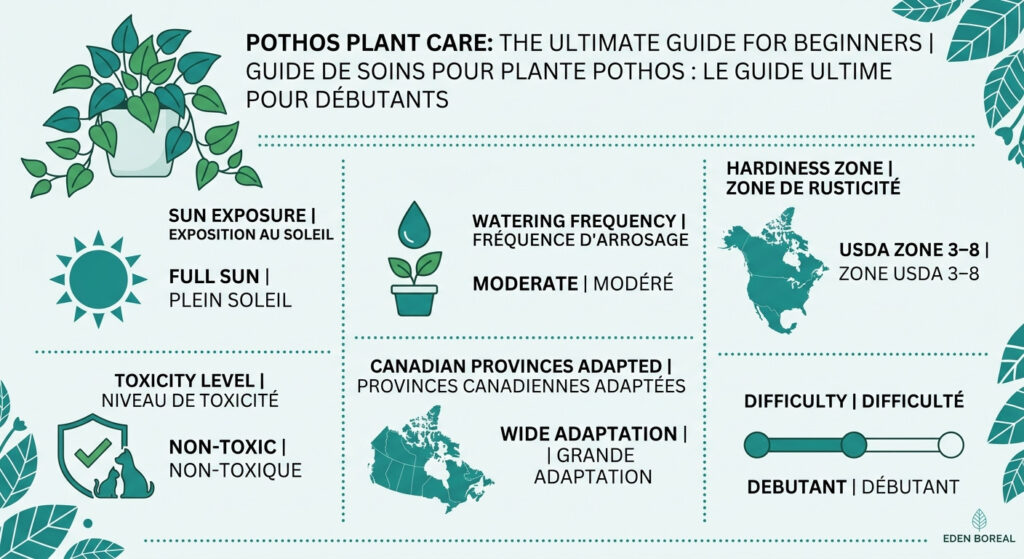
| Characteristic | Value |
|---|---|
| Botanical name | Epipremnum aureum |
| Plant type | Tropical epiphytic vine |
| Mature size | 200-300 cm trailing indoors, up to 20 m in native habitat |
| Light | 100-400 foot-candles (bright indirect), tolerates 50-100 fc |
| Watering | Every 7-14 days when top 5 cm of substrate is dry |
| Ideal temperature | 18-27°C year-round |
| Humidity | 40-70%, thrives above 60% |
| Hardiness zones (outdoors) | Zone 10-12 (not winter-hardy in Canada) |
| Toxicity | Yes, toxic to cats and dogs (insoluble calcium oxalate crystals) |
| Difficulty level | Beginner |
Epipremnum aureum vs. Philodendron: Why Pothos Isn’t What You Think It Is
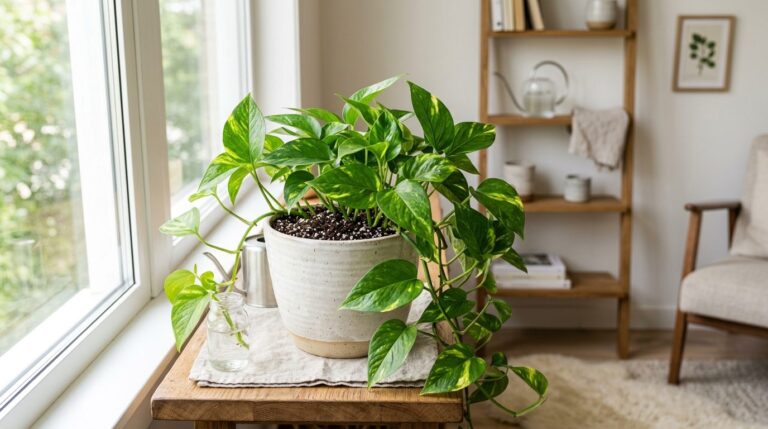
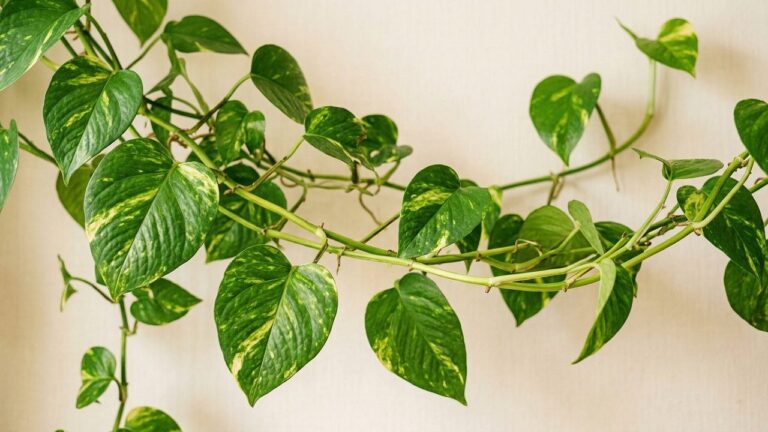
The most persistent source of confusion in Canadian garden centres is the mislabeling of Pothos as Philodendron, or vice versa. While both belong to the Araceae family and share similar heart-shaped leaves, they are distinct genera with different growth habits and care requirements. Epipremnum aureum produces thick, waxy leaves with prominent asymmetrical node structures, where each node can generate multiple aerial roots. Philodendron hederaceum (commonly sold as heartleaf philodendron) has thinner, more delicate leaves with symmetrical nodes and typically produces only one or two aerial roots per node.
Taxonomically, Pothos was reclassified from the genus Pothos to Epipremnum in 1880, yet the common name persisted, creating decades of retail confusion. In Ontario and Quebec nurseries, plants labeled “Philodendron” are frequently Epipremnum aureum cultivars, especially Golden Pothos and Marble Queen. The easiest field identification: hold a mature leaf to bright light and examine the venation pattern. Pothos displays a single central midrib with lateral veins branching at sharp angles, while Philodendron hederaceum shows a more diffuse, net-like venation with softer angles.
Practical Implications for Canadian Growers
This distinction matters because Philodendron hederaceum requires slightly higher humidity (minimum 55-60%) to prevent leaf-edge browning, whereas Pothos tolerates the drier air common in Canadian homes during winter heating seasons (often 30-40% relative humidity). If you’ve struggled with a plant labeled “Philodendron” that develops crispy leaf margins in a Calgary, Alberta (zone 4a) apartment, confirm its identity: it may be a Pothos that simply needs repositioning away from forced-air vents rather than the humidifier you assumed was necessary.
Light Thresholds Where Pothos Loses Variegation and Reverts to Solid Green
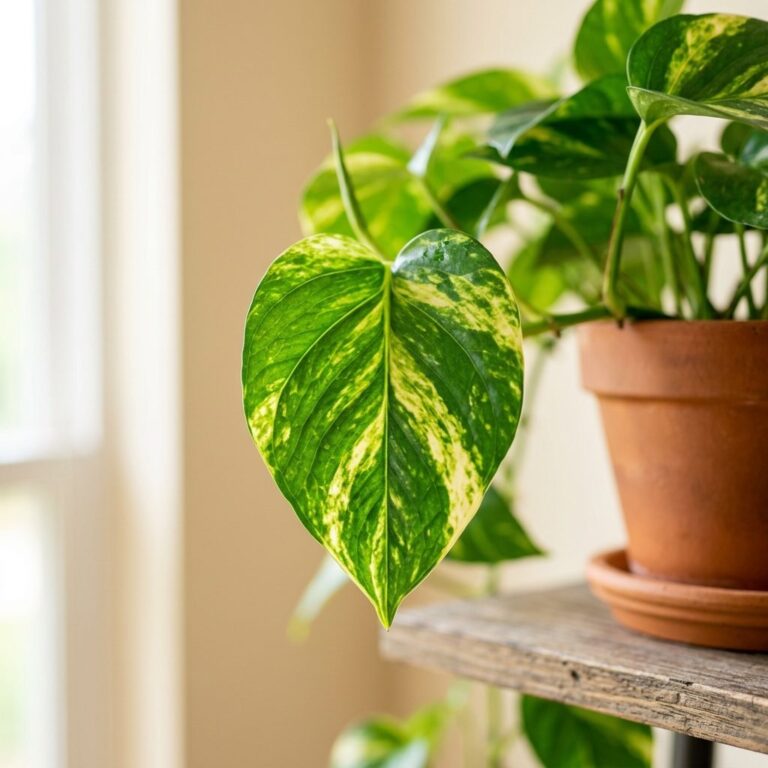
Variegation reversion is the most common disappointment reported by Canadian Pothos growers, particularly those cultivating Marble Queen, Snow Queen, or N’Joy cultivars. Variegation in Pothos results from a genetic mutation that reduces chlorophyll density in certain leaf sectors, creating white, cream, or yellow patterns. When light intensity drops below the threshold required for photosynthesis in the remaining green tissue, the plant responds by allocating more resources to chlorophyll production in new growth, gradually reverting to solid green leaves.
Research on phototropism in Araceae indicates that Epipremnum aureum cultivars with more than 40% white variegation require a minimum of 200-250 foot-candles to maintain pattern stability. In Canadian homes, this translates to placement within 1-2 metres of an unobstructed east or west window, or 50-100 cm from a south window with sheer curtains. North-facing windows in Winnipeg, Manitoba (zone 3a) during winter months often provide only 50-100 foot-candles, insufficient for highly variegated cultivars but adequate for Golden Pothos, which retains its yellow splashes down to 100 foot-candles.
Quantified Light Metrics by Cultivar
- Golden Pothos: stable variegation at 100-400 fc, tolerates 50 fc with slower growth
- Marble Queen: requires 200-400 fc, reverts below 150 fc within 3-6 months
- Snow Queen: demands 250-500 fc, highly unstable below 200 fc
- N’Joy: needs 200-350 fc, compact habit reduces reversion risk
- Cebu Blue: maintains silvery-blue sheen at 150-300 fc, less prone to reversion
Canadian growers can measure light using smartphone apps calibrated for foot-candles (such as Photone) or invest in a dedicated light meter. If reversion has already occurred, prune back to the last variegated node and relocate the plant to a brighter position; new growth will resume variegation if light exceeds the cultivar’s threshold.
Watering Frequency Based on Pothos Root System Depth and Soil Moisture Retention
The aerial root architecture of Epipremnum aureum fundamentally alters its water uptake strategy compared to terrestrial plants. In its native Solomon Islands canopy habitat, Pothos climbs tree trunks using aerial rootlets that absorb moisture from rain, fog, and humid air, while a secondary root system anchors into pockets of organic debris. Canadian indoor Pothos retain this dual system: the visible aerial roots emerging from nodes can absorb atmospheric moisture (especially in bathrooms or kitchens with 60-80% humidity), while the pot-bound roots extract water from substrate.
This physiology means Pothos tolerates drought better than overwatering. The aerial roots act as a buffer, sustaining the plant for 2-3 weeks without substrate moisture in humid environments. Overwatering, by contrast, saturates the substrate, depriving roots of oxygen and triggering root rot within 7-10 days. The classic “water when the top inch is dry” guideline fails because it ignores substrate depth and composition: a shallow 15 cm pot with peat-based mix dries faster than a deep 25 cm pot with bark and perlite.
Evidence-Based Watering Protocol
- Insert a finger or moisture probe to 5-7 cm depth (not just surface)
- Water only when substrate at that depth feels dry and crumbles when pressed
- Apply water until it drains from the pot bottom, ensuring full substrate saturation
- Discard drained water immediately; never allow the pot to sit in standing water
- In Toronto, Ontario (zone 6b) winter with forced-air heating, expect intervals of 10-14 days; in summer with higher humidity, extend to 14-21 days
Growers in Vancouver, British Columbia, where ambient humidity remains higher year-round, may find their Pothos requires watering only every 14-18 days even in summer, whereas those in Edmonton, Alberta (zone 4a) with winter indoor humidity below 25% may need to water every 7-10 days. The key metric is substrate moisture at root depth, not calendar scheduling.
Substrate Composition That Mimics Pothos Native Rainforest Canopy Environment
Generic “houseplant potting mix” sold at Canadian garden centres is formulated for terrestrial plants with fibrous root systems, not epiphytic vines like Pothos. These mixes typically contain 60-80% peat moss or coir, which retains moisture for extended periods and compacts over time, restricting oxygen flow to roots. In the wild, Epipremnum aureum grows in pockets of decomposed bark, leaf litter, and moss that drain rapidly while maintaining structure and aeration.
A substrate recipe that replicates this environment uses 40% peat-based potting soil (or coir), 30% orchid bark (medium grade, 1-2 cm chunks), 20% perlite, and 10% worm castings or aged compost. This blend drains within 10-15 seconds when watered, prevents compaction for 18-24 months, and provides slow-release nutrients. Canadian suppliers such as Lee Valley Tools and regional nurseries stock orchid bark; avoid bark labeled “mulch,” which contains larger pieces unsuitable for container culture.
Alternative Substrate for Humidity-Challenged Environments
In provinces with severe winter dryness (Saskatchewan, Alberta, interior British Columbia), a modified mix incorporating 15% sphagnum moss (long-fiber, not milled peat) increases moisture retention near aerial roots without waterlogging the substrate. Soak the sphagnum in water for 10 minutes, squeeze out excess, and blend with the base recipe, reducing perlite to 15% to compensate. This adjustment extends watering intervals by 2-4 days and raises localized humidity around the root zone, mimicking the moss-covered tree trunks Pothos climbs in nature.
Why Pothos Thrives in Bathrooms and Humid Spaces: The Aerial Root Advantage
The phenomenon of Pothos flourishing in bathrooms and kitchens is not anecdotal but rooted in the plant’s aerial root physiology. Each node along the stem produces specialized rootlets covered in a velamen layer, a spongy tissue that absorbs water vapor directly from the air. In environments with sustained humidity above 60%, these aerial roots contribute 10-20% of the plant’s total water uptake, reducing reliance on substrate moisture and enabling the plant to tolerate longer intervals between watering.
Canadian bathrooms, especially those with daily showers, maintain humidity levels of 60-75% for several hours post-use, ideal for activating aerial root absorption. A Marble Queen Pothos positioned on a shelf 1-2 metres from a shower in a Halifax, Nova Scotia (zone 6b) bathroom will produce thicker stems, larger leaves (up to 15-20 cm vs. 8-12 cm in drier rooms), and more vigorous growth than the same cultivar in a living room with 35-40% humidity.
Optimizing Non-Bathroom Placements
For growers without suitable bathroom light, replicate humidity benefits by grouping Pothos with other plants to create a localized microclimate, or placing the pot on a tray filled with 2-3 cm of pebbles and water (ensuring the pot base sits above water level). In Ottawa, Ontario (zone 5a) during winter, a humidifier set to maintain 50-60% in the plant’s immediate vicinity will stimulate aerial root development and reduce leaf-edge browning, a common symptom of prolonged exposure to 25-30% humidity from forced-air heating.
Stem Cuttings vs. Node Propagation: The Correct Method for Pothos Multiplication
Propagation confusion arises from imprecise terminology: “stem cutting” is often used to describe any severed piece of vine, but successful Pothos propagation depends on including at least one node with an intact aerial root primordium. A node is the swollen joint where a leaf petiole attaches to the stem; the asymmetrical node structure of Epipremnum aureum contains dormant meristematic tissue capable of generating both roots and shoots.
Cuttings taken between nodes, containing only stem tissue and leaves, will not root. The correct method: use sterilized pruning shears to cut 2-3 cm below a node, ensuring the cutting includes the node and at least one leaf. Remove the lowest leaf if it would sit below the waterline during rooting. Place cuttings in a clear container of room-temperature water (18-22°C) in bright indirect light (200-400 foot-candles). Roots emerge from the node within 7-14 days in optimal conditions; Canadian growers in Calgary or Saskatoon may see slower rooting (14-21 days) due to lower ambient temperatures and humidity.
Soil Propagation for Faster Establishment
Water propagation is visually satisfying but delays substrate adaptation. Direct soil propagation using a mix of 50% perlite and 50% peat (or coir) produces roots that transition to potting mix without shock. Insert the node 2-3 cm deep, water thoroughly, and cover the container with a clear plastic bag to maintain 80-90% humidity around the cutting. Place in bright indirect light and check moisture every 3-4 days. Roots establish within 14-21 days, and the cutting can be transplanted to standard substrate after 4-6 weeks. This method yields a 15-20% faster growth rate in the first three months compared to water-rooted cuttings.
Pothos Varieties Ranked by Variegation Stability and Light Tolerance
Canadian availability of Pothos cultivars has expanded significantly since 2018, with specialty growers in Ontario and British Columbia importing rare varieties previously unavailable outside collector circles. However, not all cultivars perform equally in typical Canadian indoor light conditions. The following ranking is based on variegation stability (resistance to reversion), minimum light tolerance, and growth rate observed across multiple Canadian climate zones.
Tier 1: Beginner-Friendly, Stable Variegation
- Golden Pothos: 30-40% yellow variegation, stable down to 100 fc, growth rate 15-20 cm/month in optimal conditions, universally available at Canadian garden centres
- Jade Pothos: solid green, no variegation to lose, tolerates 50 fc, fastest growth rate (20-30 cm/month), ideal for low-light basement or north-facing rooms in Montreal
- Cebu Blue: silvery-blue juvenile leaves, 10-15% lighter sectoring, stable at 150 fc, slower growth (10-15 cm/month), increasingly available through specialty nurseries
Tier 2: Intermediate, Requires Monitoring
- Marble Queen: 50-60% white variegation, requires 200 fc minimum, reverts within 4-6 months below threshold, growth rate 10-15 cm/month, widely available but often mislabeled
- N’Joy: 40-50% white variegation in blocky patterns, more stable than Marble Queen due to compact internodes, needs 200 fc, growth rate 8-12 cm/month, patented cultivar released 2002, available at premium nurseries
- Pearls and Jade: 30-40% white and grey-green variegation, stable at 180 fc, compact habit (6-10 cm/month), sport of Marble Queen discovered in University of Florida breeding program
Tier 3: Advanced, High Light Demand
- Snow Queen: 70-80% white variegation, demands 250 fc minimum, extremely prone to reversion, growth rate 5-8 cm/month, rare in Canadian retail, often imported from U.S. specialty growers
- Manjula Pothos: 50-60% white and cream variegation with wavy leaf margins, requires 220 fc, patented cultivar released 2014, moderate stability, available through online Canadian plant shops
- Global Green: 20-30% dark green and chartreuse marbling, stable at 180 fc, compact growth (6-10 cm/month), released 2020, limited Canadian availability as of 2025
Growers in Regina, Saskatchewan (zone 3b) or other low-light winter environments should prioritize Tier 1 cultivars or invest in supplemental LED grow lights (minimum 20 watts per square metre) to maintain Tier 2 and 3 varieties.
Diagnosing Root Rot, Leggy Growth, and Nutrient Deficiency in Pothos
Root rot is the leading cause of Pothos mortality in Canadian homes, typically resulting from overwatering in poorly draining substrate. Early symptoms appear 7-14 days after root damage begins: lower leaves turn yellow (starting at the petiole base), then brown and mushy. If caught within the first 10 days, recovery is possible by removing the plant from its pot, trimming all brown, soft roots back to white tissue, and repotting in fresh, aerated substrate. Delay beyond 14 days allows fungal pathogens (Pythium, Phytophthora) to colonize the stem, at which point only propagation from healthy upper cuttings can save the plant.
Leggy growth, characterized by elongated internodes (8-12 cm between leaves vs. the normal 3-5 cm), signals insufficient light. This is not a disease but a phototropic response: the plant stretches toward the light source, sacrificing leaf density. The solution is relocation to a brighter position (200+ foot-candles) and pruning back to a node closer to the base to encourage bushier regrowth. In Yellowknife, Northwest Territories (zone 1a), where winter daylight is limited to 4-6 hours, supplemental lighting is essential to prevent legginess in all cultivars.
Nutrient Deficiency Symptom Matrix
- Nitrogen deficiency: older leaves pale yellow, new growth small and light green, corrected with balanced liquid fertilizer (20-20-20) at half strength every 4-6 weeks during active growth
- Magnesium deficiency: interveinal chlorosis (yellowing between veins) on older leaves, common in peat-based substrates, treated with Epsom salt solution (1 teaspoon per litre, applied once)
- Iron deficiency: interveinal chlorosis on new leaves, rare in Pothos but possible in alkaline water regions (parts of Alberta, Saskatchewan), corrected with chelated iron supplement
- Calcium deficiency: new leaves distorted or necrotic at tips, extremely rare, indicates severe substrate imbalance or exclusive use of distilled water
Canadian tap water in most municipalities provides adequate calcium and magnesium; growers using reverse osmosis or distilled water should remineralize with a cal-mag supplement or alternate with tap water every third watering.
Devil’s Ivy Toxicity and Safe Placement Around Pets and Children
The common name “Devil’s Ivy” reflects Pothos‘ reputation for near-indestructibility, not its toxicity, yet the plant does contain insoluble calcium oxalate crystals in all tissues. These needle-shaped crystals cause immediate mechanical irritation when chewed, triggering intense oral pain, drooling, and localized swelling in cats, dogs, and humans. Crucially, calcium oxalate is not a systemic poison: it does not enter the bloodstream or cause organ damage. Symptoms resolve within 2-6 hours without treatment in most cases, though severe reactions (difficulty swallowing, airway swelling) warrant veterinary attention.
For Canadian households with pets, placement strategies reduce risk more effectively than avoidance. Cats are deterred by height: mounting Pothos on a wall shelf 180 cm or higher places it beyond typical jumping range. Dogs rarely chew hanging plants but may investigate floor-level pots; elevating the plant on a plant stand or suspending it from a ceiling hook eliminates access. Children under 3 years explore by mouthing objects; keep Pothos out of reach and teach older children to recognize the plant as non-edible.
Emergency Response Protocol
- Remove any plant material from the mouth immediately
- Rinse the mouth with room-temperature water for 10-15 minutes
- Offer small amounts of milk or yogurt to coat the oral mucosa and reduce irritation
- Monitor for worsening symptoms (difficulty breathing, excessive swelling) for 2 hours
- Contact a veterinarian (for pets) or Poison Control Centre (for humans) if symptoms persist beyond 4 hours or worsen
The Canadian Poison Control Centre reports fewer than 50 annual calls related to Epipremnum aureum ingestion, with zero fatalities recorded. The plant’s reputation as highly toxic is disproportionate to actual risk when compared to truly dangerous species like Dieffenbachia or Nerium oleander. Informed placement and supervision render Pothos a manageable choice for multi-species households across all Canadian provinces.