

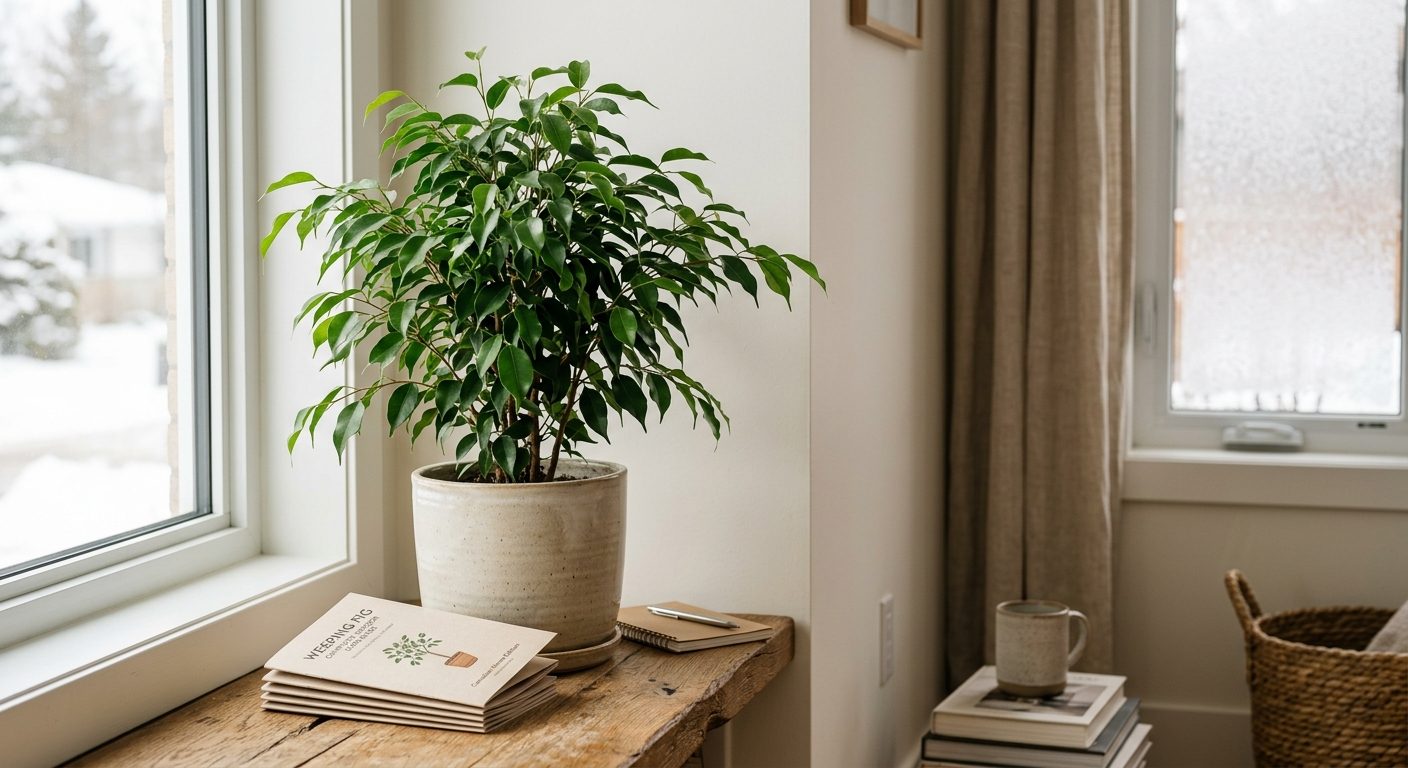
Why Weeping Fig Remains a Canadian Indoor Staple Despite Its Reputation
The Weeping Fig (Ficus benjamina) has earned both devotion and frustration among Canadian indoor gardeners. Native to the tropical understory of Malaysia and Southeast Asia, this member of the Moraceae family adapts remarkably well to controlled environments in Ontario, Quebec, and British Columbia homes-provided you respect its physiological non-negotiables. Unlike the structural rigidity of Ficus lyrata or the drought tolerance of Ficus elastica, benjamina exhibits pronounced phototropic behavior and a shallow, fibrous root system that demands precision rather than routine. In USDA zones 3 through 7, where outdoor cultivation is impossible, understanding these traits transforms a leaf-dropping nightmare into a reliable, decades-long indoor companion.
| Characteristic | Value |
|---|---|
| Botanical name | Ficus benjamina |
| Plant type | Tropical evergreen tree |
| Mature size | 90-180 cm indoors (can reach 300 cm in optimal greenhouse conditions) |
| Light | Bright indirect, 200-400 foot-candles minimum |
| Watering | When top 3-5 cm of substrate feels dry; every 5-9 days depending on season and humidity |
| Ideal temperature | 18-24°C year-round, avoid drops below 15°C |
| Humidity | 45-65% relative humidity |
| Hardiness zones (outdoors) | Zone 10-12 (not viable outdoors in Canada) |
| Toxicity | Yes, toxic to cats and dogs (latex sap irritant) |
| Difficulty level | Intermediate |
Understanding Ficus benjamina: Botanical Identity and Why It Thrives Indoors
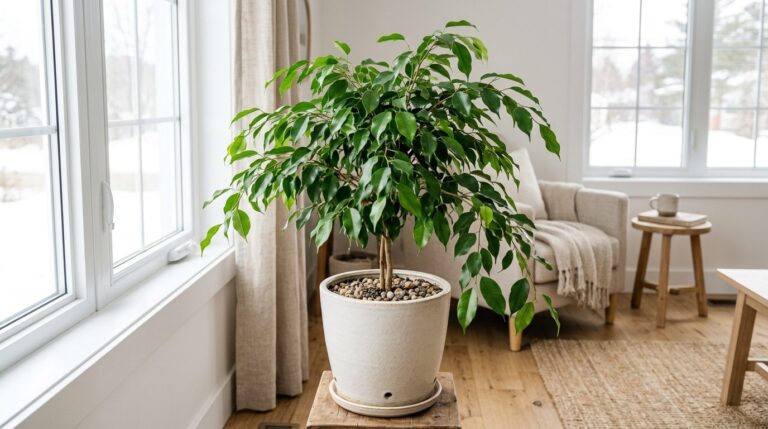
Ficus benjamina belongs to a genus of over 850 species, but its specific adaptation to the tropical understory makes it uniquely suited to the lower light levels of Canadian interiors. In its native range, benjamina grows as a canopy tree reaching 30 meters, but juveniles spend years in dappled shade, developing tolerance for 200-400 foot-candles-roughly equivalent to a north-facing window in Toronto or a shaded east exposure in Vancouver. This evolutionary history explains why it outperforms sun-demanding tropicals like Hibiscus or Citrus in typical home conditions.
The plant’s fibrous root system spreads laterally rather than deeply, a trait shared with other tropical epiphytes and understory species. Roots rarely penetrate beyond 15-20 cm in container culture, concentrating in the top third of the pot. This shallow architecture makes benjamina exceptionally sensitive to substrate saturation-waterlogged roots in the critical top layer trigger leaf abscission within 48-72 hours, a survival mechanism to reduce transpiration load when oxygen exchange is compromised.
Taxonomic Context and Cultivar Diversity
Within the Moraceae family, benjamina shares closer kinship with edible figs (Ficus carica) than with the popular Fiddle Leaf Fig (Ficus lyrata). This relationship manifests in similar latex sap chemistry-both produce irritant compounds that cause contact dermatitis in sensitive individuals and mild gastrointestinal upset in pets. The Starlight cultivar, introduced in the 1980s, features variegated foliage with cream margins that reduce chlorophyll density by approximately 30%, lowering its minimum light threshold to 150 foot-candles but slowing growth rate by 40% compared to standard green forms.
Light Requirements and Phototropic Behavior in Weeping Fig
Ficus benjamina exhibits phototropism-directional growth toward light sources-more aggressively than most houseplants. Stems can reorient by 15-20 degrees within a week when light direction shifts, a trait that causes the infamous “leaf drop after moving” syndrome. In Alberta or Saskatchewan homes with limited winter daylight, maintaining a fixed position relative to windows becomes critical. A plant receiving 300 foot-candles from a south-facing window in Calgary will drop 20-30% of its foliage if rotated 180 degrees, even if total light quantity remains unchanged.
Quantified thresholds matter more than vague “bright indirect” advice. Measure light with a smartphone lux meter app (convert lux to foot-candles by dividing by 10.76) at foliage height, midday, on a typical cloudy day. Target readings:
- Minimum survival threshold: 150 foot-candles (green cultivars), 100 foot-candles (variegated cultivars like Starlight)
- Compact growth with minimal leaf drop: 250-400 foot-candles
- Optimal for branching and dense canopy: 400-600 foot-candles
- Upper tolerance before leaf scorch: 800 foot-candles (avoid direct sun through glass in summer)
Seasonal Adjustments for Canadian Light Cycles
In zone 4 Quebec, December solstice light intensity drops to 40% of June levels. A south window providing 400 foot-candles in summer may deliver only 160 foot-candles in winter, pushing benjamina below its compact-growth threshold. Supplement with a 6500K LED grow light positioned 30-45 cm above the canopy, running 12-14 hours daily from November through February. This prevents the etiolation (internode stretching) and gradual leaf thinning that accumulates over multiple Canadian winters.
Phototropic Response Versus True Light Stress
Distinguish between phototropic reorientation (stems bending, no leaf loss) and genuine light deficiency (yellowing lower leaves, widening internodes). Phototropic bending is cosmetic and reversible; rotate the plant 90 degrees monthly to encourage symmetrical growth. Light deficiency causes chlorosis in the oldest leaves first, progressing upward-these leaves abscise cleanly at the petiole junction, leaving no stub. If more than 5-8 leaves drop per month in a mature specimen, light is inadequate regardless of window proximity.
Watering Strategy Based on Soil Moisture Signals, Not Calendar Dates
The shallow root concentration of Ficus benjamina creates a narrow margin between drought stress and overwatering. Roots occupy the top 5-8 cm most densely, with sparse colonization below 15 cm. This distribution means traditional “water when the top inch is dry” guidance is imprecise-by the time the top 2.5 cm dries, the critical root zone at 5-7 cm may already be parched, triggering emergency leaf drop.
Instead, use a wooden skewer or moisture probe inserted to 6-7 cm depth. Water when this zone reaches “barely moist” (skewer shows faint dampness but no adhering particles). In a typical Ontario apartment at 21°C and 40% humidity, this interval averages 6-8 days in summer, 9-12 days in winter. High-humidity British Columbia coastal homes may extend winter intervals to 14 days, while forced-air heated Alberta homes may shorten them to 5 days.
Volume and Technique for Fibrous Root Systems
Apply water until it begins to seep from drainage holes, then stop-typically 15-20% of pot volume for a well-draining substrate. For a 25 cm diameter pot, this equals approximately 800-1000 mL. Avoid the common error of multiple small waterings that wet only the top 3 cm; fibrous roots need thorough saturation of their entire zone followed by partial drying. Discard any water remaining in the saucer after 15 minutes to prevent the bottom 2-3 cm of substrate from becoming a stagnant reservoir.
Diagnosing Root Zone Health Without Unpotting
Lift the pot 24 hours after watering. A 25 cm pot with healthy substrate should feel noticeably heavier (approximately 1.5-2 kg increase) than when dry. If weight gain is minimal, the substrate has become hydrophobic-common with peat-heavy mixes after 18-24 months. Remedy by bottom-watering: place the pot in a basin with water level at half the pot height for 20-30 minutes, allowing capillary action to rewet the root zone. This is preferable to top-watering hydrophobic substrate, which channels down the pot sides without penetrating the root ball.
Soil Composition and Root System Needs for Ficus benjamina
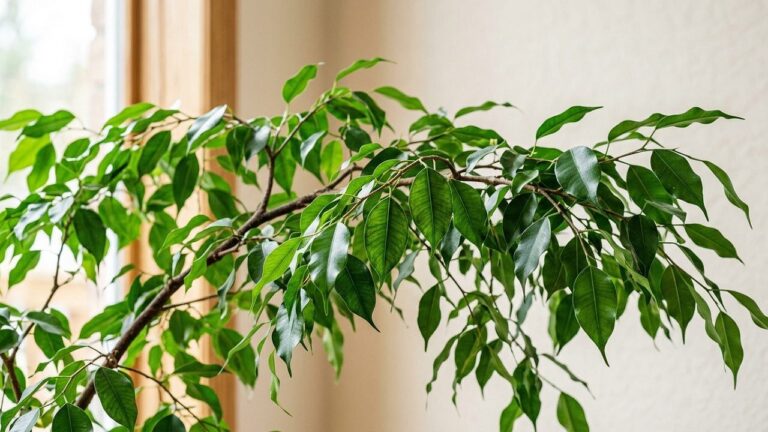
Standard potting mixes from Canadian garden centers-typically 70-80% peat moss with minimal drainage amendments-compact within 12-18 months, suffocating the shallow roots of benjamina. The ideal substrate balances moisture retention in the top 5 cm (where root density peaks) with rapid drainage below 10 cm (where roots are sparse and anaerobic conditions develop quickly).
Recommended recipe by volume:
- 50% quality potting soil (peat- or coir-based, available at any Canadian nursery)
- 25% perlite (horticultural grade, 3-6 mm particle size)
- 15% orchid bark (medium grade, 6-12 mm chunks)
- 10% coarse sand or pumice (optional, improves long-term structure)
This mix achieves a water retention of approximately 40% by volume in the top layer while draining to field capacity within 2-3 minutes-critical for preventing the 48-hour saturation window that triggers root rot. The orchid bark component creates air pockets that persist even as peat decomposes, extending substrate lifespan to 30-36 months before repotting becomes necessary.
Particle Size and Root Penetration Dynamics
Ficus benjamina roots are 1-2 mm diameter at maturity, finer than those of Monstera or Philodendron. Substrates with particles larger than 15 mm (common in some orchid bark mixes) create voids too large for effective root contact, reducing water uptake efficiency. Conversely, fine particles below 1 mm (dust fraction in degraded peat) fill air spaces, dropping oxygen availability below the 10% threshold needed for aerobic root respiration. Screen your substrate through a 3 mm mesh before mixing to remove both extremes.
Fertilization Aligned with Root Concentration
Because 80% of absorptive roots occupy the top third of the pot, broadcast granular fertilizers (which release nutrients downward with each watering) waste half their payload below the root zone. Use liquid fertilizer at half the label rate, applied with every second watering from April through September in zone 5 Ontario. A balanced 10-10-10 or 7-9-5 formulation supports the moderate growth rate of indoor benjamina without forcing the soft, disease-prone growth caused by high-nitrogen feeding. Suspend fertilization from October through March when growth stalls and nutrient demand drops by 70%.
Humidity Management and Temperature Stability for Tropical Acclimation
Ficus benjamina originates from regions with year-round 70-85% relative humidity, but it acclimates to Canadian indoor levels of 30-50% provided temperature remains stable. The critical failure point is not low humidity per se, but the combination of low humidity (<35%) and temperature fluctuations exceeding 4°C within 24 hours. This combination disrupts stomatal regulation, causing marginal leaf browning and premature abscission of mature leaves.
In zone 3 Manitoba homes with forced-air heating, winter humidity often drops to 20-25%, while temperature swings from 22°C daytime to 16°C nighttime (near windows) are common. Address this with:
- Evaporative humidifier maintaining 45-55% RH in the plant’s immediate zone (2-3 meter radius)
- Thermal mass placement: position the pot 1.5-2 meters from heating vents and away from exterior walls where nighttime cold radiates through insulation
- Grouping with other tropicals to create a localized humidity microclimate via collective transpiration
Marginal Leaf Browning as a Diagnostic Tool
Brown leaf margins progressing inward by 2-5 mm indicate humidity below the plant’s compensation point (approximately 35% RH for acclimated specimens). This differs from the crisp, uniform browning of fluoride toxicity (rare in Canadian municipal water) and the irregular, pathogen-associated browning of fungal leaf spot. Humidity-induced browning affects the oldest leaves first and remains confined to margins, never crossing into interveinal tissue unless secondary infection occurs.
Temperature Tolerance and Cold Damage Thresholds
Ficus benjamina tolerates brief exposure to 13°C without permanent damage, but sustained periods below 15°C trigger metabolic slowdown and increased susceptibility to root rot (fungal activity remains high while root defenses weaken). In Quebec or Nova Scotia homes, avoid placing plants near single-pane windows where nighttime temperatures can drop to 8-10°C even when room air reads 20°C. A simple test: place a minimum-maximum thermometer at foliage height for one week to capture true microclimate extremes.
Leaf Drop Diagnosis: Distinguishing Overwatering from Light Stress
Leaf abscission in Ficus benjamina is a non-specific stress response, making diagnosis challenging without systematic observation. However, the pattern, timing, and leaf condition before drop provide reliable clues. Overwatering and light deficiency-the two most common causes in Canadian homes-produce distinct signatures.
Overwatering signature:
- Leaves remain green and turgid until the moment of abscission
- Drop occurs 48-96 hours after a watering event
- Affects randomly distributed leaves across the canopy, not concentrated in lower or interior zones
- Substrate remains visibly moist (dark) 7+ days after watering
- Pot feels heavy relative to dry weight even 5-6 days post-watering
Light deficiency signature:
- Leaves yellow progressively over 7-14 days before dropping
- Affects lower and interior leaves first (shaded by upper canopy)
- Drop rate correlates with seasonal light reduction (peaks November-January in zone 4-6)
- New growth shows elongated internodes (>4 cm between leaves vs. 2-3 cm in adequate light)
- Substrate drying rate is normal (5-9 days depending on season)
Quantifying Acceptable Leaf Loss Rates
A healthy 90 cm tall benjamina with approximately 200-300 leaves naturally drops 2-4 leaves monthly as part of normal senescence. This baseline increases to 5-8 leaves monthly during the transition from outdoor summer placement (if applicable in zone 6-7) to indoor fall conditions. Leaf drop exceeding 10 leaves per month for more than two consecutive months indicates actionable stress, not mere acclimation.
Secondary Causes: Relocation Shock and Drafts
Moving a benjamina between rooms-even without changing light quantity-triggers phototropic disorientation and temporary leaf drop as the plant reorients growth. Minimize this by maintaining the same orientation relative to the light source when relocating. Cold drafts from opening doors in Alberta winters (outdoor air at -20°C mixing with indoor air) can cause localized leaf drop on the side facing the draft, identifiable by the sudden browning and drop of leaves in a vertical stripe pattern within 24-48 hours of exposure.
Pruning Techniques to Control Shape and Encourage Branching
Ficus benjamina exhibits apical dominance-the terminal bud suppresses lateral bud development through auxin signaling. Left unpruned, specimens develop a sparse, tree-like form with long unbranched stems. Strategic pruning redirects growth hormones to axillary buds (located at each leaf node), producing the dense, shrubby canopy preferred for indoor display.
Prune in late March or early April in zone 5 Quebec, just as lengthening photoperiod triggers active growth. Cuts made during dormancy (November-February) heal slowly and risk dieback, while cuts during peak growth (June-July) produce excessive sap flow and weak, leggy regrowth.
Node-Based Cutting for Predictable Branching
Identify nodes by the slight swelling where a leaf petiole attaches (or previously attached). Each node contains 1-3 dormant buds. Cut 5-8 mm above a node at a 45-degree angle using clean, sharp bypass pruners. Cuts made between nodes (internodal cuts) result in dieback to the next lower node, wasting stem length and creating entry points for fungal infection.
Expect 1-2 new shoots per cut within 3-5 weeks under adequate light (300+ foot-candles). Lower light delays bud break to 6-8 weeks and often produces only a single weak shoot. To create a bushy specimen, prune 30-40% of stem tips annually, focusing on the longest, most vertical stems. This maintains a compact 60-90 cm height indefinitely in a 25-30 cm pot.
Managing Latex Sap During Pruning
Cuts release white latex sap containing ficin proteases and allergenic compounds. Sap flow stops within 2-3 minutes as proteins coagulate, sealing the wound. Avoid “sealing” cuts with wax or paste-this traps moisture and increases rot risk. Instead, allow natural coagulation, then wipe tools with isopropyl alcohol to prevent sap buildup. Wear nitrile gloves if you have latex sensitivity; skin contact causes irritation in approximately 15-20% of individuals.
Propagation Methods and Success Rates for Stem Cuttings
Ficus benjamina propagates reliably from semi-hardwood stem cuttings taken during active growth (April-June in zone 4-6 Canada). Success rates of 70-85% are achievable with attention to cutting maturity, rooting environment, and hormone application.
Select stems that have lignified (turned from green to light brown) but retain some flexibility-typically current-season growth that is 3-5 months old. Cut 10-15 cm lengths with 3-4 nodes, removing leaves from the bottom two nodes. Dip the cut end in rooting hormone powder containing 0.3-0.8% IBA (indole-3-butyric acid), available at Canadian garden centers as products like Stim-Root or Rootone.
Rooting Medium and Environmental Control
Insert cuttings 3-4 cm deep in a sterile medium of 50% perlite, 50% peat moss or 100% coarse vermiculite. Avoid potting soil, which retains excessive moisture and promotes fungal rot before roots develop. Maintain substrate temperature at 22-25°C using a seedling heat mat-root initiation slows by 50% at 18°C and stalls below 15°C, common in unheated basements or garages used for propagation.
Enclose cuttings in a clear plastic dome or bag to maintain 80-90% humidity, preventing desiccation before roots form. Vent daily for 10-15 minutes to prevent fungal growth. Roots emerge from nodes in 3-4 weeks at optimal temperature, extending to 6-8 weeks in cooler conditions. Confirm rooting by gently tugging the cutting-resistance indicates root anchorage.
Transition to Potting and Acclimation
Once roots reach 2-3 cm length, transplant to 10 cm pots filled with the standard substrate mix described earlier. Gradually reduce humidity over 10-14 days by increasing vent time, preventing the shock of abrupt transition from 90% to 40% RH. New growth appears 2-3 weeks post-transplant; begin quarter-strength liquid fertilizer at this point. Expect propagated cuttings to reach 30-40 cm height within 12 months under 300+ foot-candle light in an Ontario or Quebec home.
Cultivar Comparison: Starlight, Wintergreen, and Other Indoor Varieties
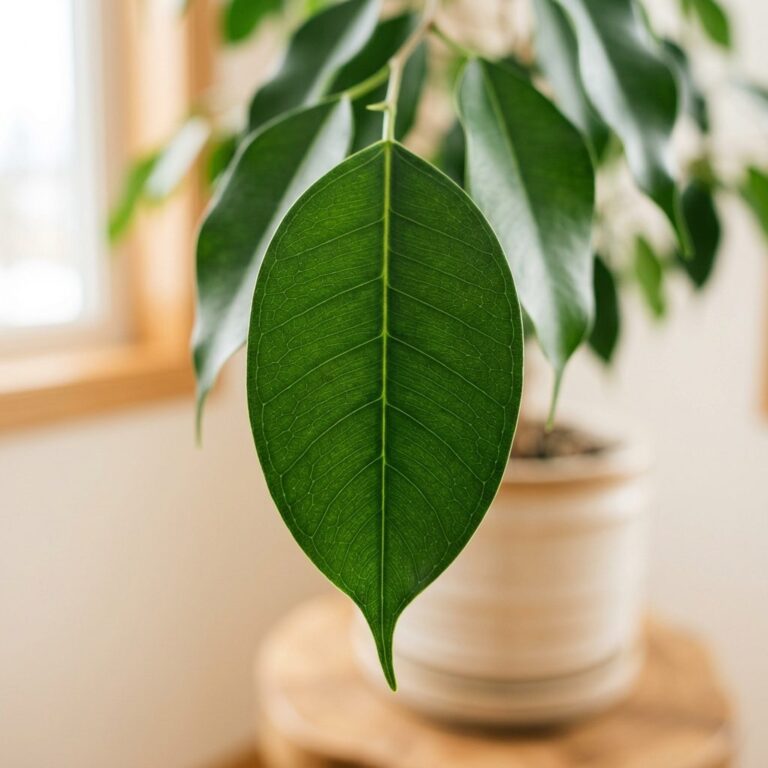
Ficus benjamina cultivars differ significantly in light tolerance, growth rate, and foliar variegation, making cultivar selection critical for matching plant to environment. Canadian availability varies by region, with Starlight and standard green forms widely stocked, while specialty cultivars like Wintergreen or Twilight appear sporadically at independent nurseries in Vancouver, Toronto, and Montreal.
Standard green Ficus benjamina:
- Minimum light: 200 foot-candles
- Growth rate: 20-30 cm annual height gain in optimal conditions
- Leaf characteristics: uniform dark green, 5-8 cm length, smooth margins
- Best for: bright rooms, offices with large windows, zone 5-7 sunrooms (summer only)
Starlight cultivar:
- Minimum light: 150 foot-candles (variegation reduces chlorophyll, lowers threshold)
- Growth rate: 12-18 cm annual height gain (40% slower than green forms)
- Leaf characteristics: cream to white margins occupying 30-50% of leaf area, occasional fully white leaves
- Best for: moderate light rooms, north-facing windows in British Columbia, decorative contrast plantings
- Caution: reverts to green if light drops below 120 foot-candles for extended periods
Wintergreen cultivar:
- Minimum light: 180 foot-candles
- Growth rate: 15-22 cm annual height gain
- Leaf characteristics: dark green with subtle lighter veining, slightly smaller leaves (4-6 cm), denser branching habit
- Best for: compact spaces, tabletop specimens, slower-growing alternative to standard forms
- Availability: limited in Canada, occasionally at specialty growers in Ontario
Performance Metrics in Canadian Indoor Conditions
In a controlled comparison at 250 foot-candles (typical east-facing window in Toronto), standard green benjamina produced 22 cm height gain over 12 months, while Starlight managed 13 cm and Wintergreen 17 cm. Leaf drop during a simulated relocation event (180-degree rotation) affected 18% of foliage in standard green, 24% in Starlight (variegated tissue is more stress-sensitive), and 15% in Wintergreen (denser branching provides more reserve leaves).
Sourcing Cultivars from Canadian Nurseries
Major chains (Home Depot, Lowe’s, Canadian Tire garden centers) stock standard green and Starlight year-round in 15-25 cm pot sizes. Specialty cultivars require independent nurseries: Sheridan Nurseries (Ontario), Art’s Nursery (British Columbia), and Jardin Dion (Quebec) occasionally carry Wintergreen and the rarer Twilight (deep purple-green foliage). Expect to pay $25-45 for standard 20 cm pot specimens, $40-70 for Starlight, and $60-90 for rare cultivars when available.
Ficus benjamina rewards Canadian indoor gardeners who respect its physiological imperatives: stable light above 200 foot-candles, soil moisture monitoring in the critical 5-7 cm root zone, and temperature stability within 18-24°C. Master these fundamentals, and the notorious “leaf-dropping ficus” transforms into a decades-long companion, tolerating the low humidity and limited winter light of zones 3-7 far better than its tropical reputation suggests.