

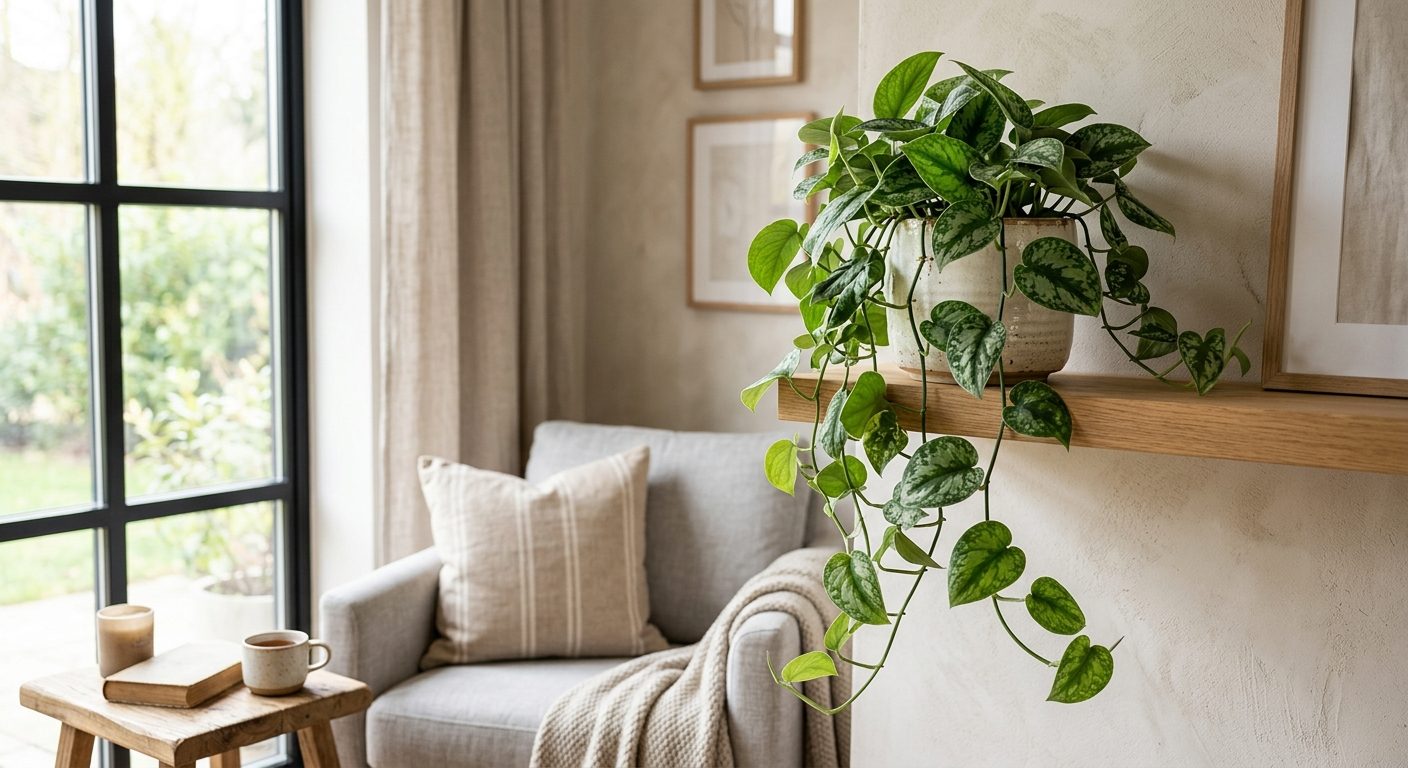
Why Scindapsus Pictus Thrives in Canadian Homes
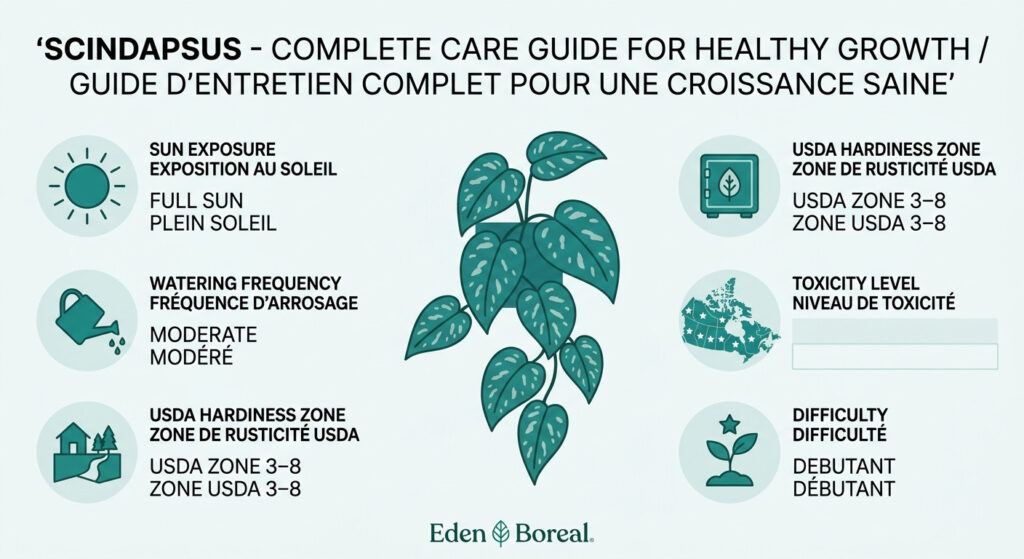
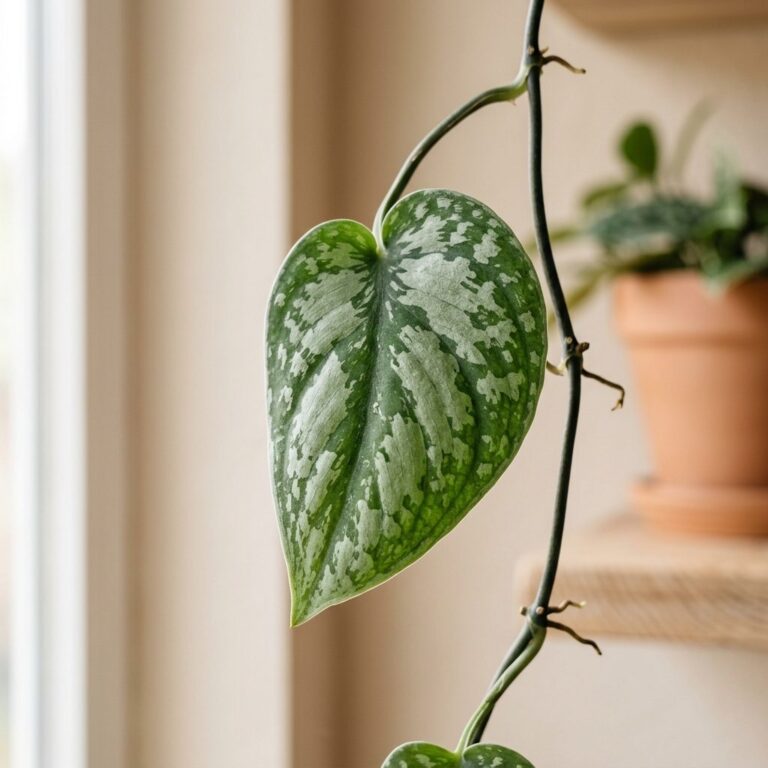
Across Ontario and Quebec apartments, Scindapsus pictus has earned its reputation as a low-maintenance climber that tolerates the dry indoor air of Canadian winters. Unlike fast-growing vines that demand constant pruning, this species from Southeast Asia grows at a measured pace, extending 15-20 cm per growing season under typical household conditions. Its velvety leaves, covered in microscopic papillae that scatter light into silver patterns, distinguish it from the ubiquitous Golden Pothos sold at every garden centre. Gardeners in zone 4 and zone 5 regions appreciate that Scindapsus pictus requires no dormancy period, maintaining its foliage year-round when kept above 15°C. The shallow root system, rarely exceeding 15 cm depth in a standard pot, makes this vine particularly forgiving of irregular watering schedules. This guide provides quantified care parameters based on root physiology, light thresholds measured in foot-candles, and substrate ratios tested in Canadian indoor conditions, ensuring your Scindapsus pictus develops dense variegation rather than reverting to plain green.
| Characteristic | Value |
|---|---|
| Botanical name | Scindapsus pictus |
| Plant type | Tropical climbing vine |
| Mature size | 200-300 cm trailing length indoors |
| Light | Bright indirect light, 100-200 foot-candles |
| Watering | Every 7-10 days when top 5 cm of substrate dries |
| Ideal temperature | 18-27°C |
| Humidity | 40-60% |
| Hardiness zones (outdoors) | Zone 10-11 (indoor cultivation only in Canada) |
| Toxicity | Yes, toxic to cats and dogs due to calcium oxalates |
| Difficulty level | Beginner |
Understanding Scindapsus Pictus: Morphology and Why It Differs from Epipremnum Aureum
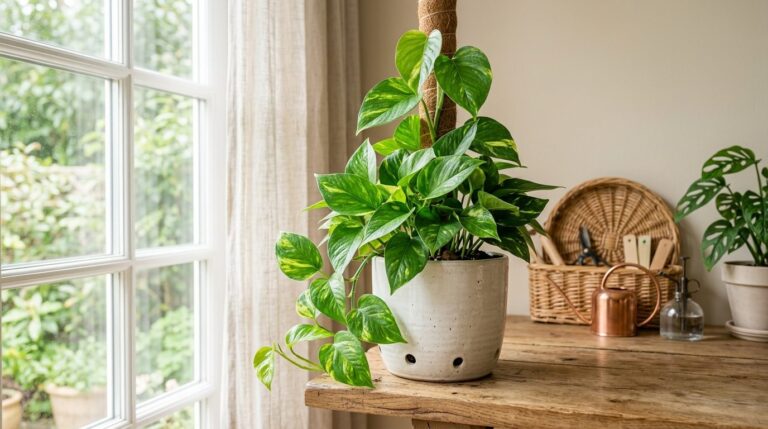
Botanical confusion between Scindapsus pictus and Epipremnum aureum persists in Canadian nurseries, where both are marketed as “pothos” despite belonging to separate genera within the Araceae family. The key morphological distinction lies in leaf texture: Scindapsus pictus produces leaves with a matte, almost suede-like surface created by dense papillae, while Epipremnum aureum displays glossy, waxy foliage. This textural difference directly impacts care requirements. The papillae on Scindapsus leaves reduce transpiration rates by 30-40% compared to smooth-leaved vines, meaning this species tolerates lower humidity levels common in heated Canadian homes during winter months. In British Columbia coastal regions where ambient humidity naturally reaches 60-70%, Scindapsus pictus grows with minimal intervention, but in the dry Prairie climates of Alberta and Saskatchewan, the papillae prevent the leaf-edge browning that plagues Epipremnum aureum.
Root architecture further separates these genera. Scindapsus pictus develops a shallow, fibrous root system concentrated in the top 12-15 cm of substrate, with minimal aerial root production compared to Epipremnum species. This shallow rooting habit evolved in the plant’s native habitat on Mo’orea and surrounding Pacific islands, where it climbs over thin organic matter layers on limestone substrates. In practical terms, Scindapsus pictus thrives in wider, shallower pots (15 cm depth sufficient for mature specimens) rather than the deep containers recommended for Golden Pothos. Canadian growers in zone 3 and zone 4 regions benefit from this trait, as shallow pots dry more uniformly, reducing the risk of anaerobic conditions and root rot during the low-light months of November through February when evapotranspiration slows.
Variegation Genetics and Cultivar Differences
Commercial Scindapsus pictus cultivars available in Canada include ‘Argyraeus’ (small silver spots), ‘Exotica’ (larger splashes), and ‘Silvery Ann’ (nearly 80% silver coverage). The variegation results from chimeral tissue where chlorophyll-deficient cells form stable patterns, unlike the viral variegation in some Epipremnum cultivars. This genetic stability means Scindapsus pictus rarely reverts to solid green if light conditions remain adequate. However, new growth on ‘Silvery Ann’ may show reduced silver if foot-candle readings drop below 75 for extended periods. Growers in Ontario have documented that north-facing windows in Toronto apartments (typically 50-100 foot-candles in winter) maintain existing variegation but produce smaller, less dramatic silver patterns on new leaves compared to east-facing exposures.
Light Thresholds and Variegation Loss: Quantified Brightness Requirements
Precise light measurement eliminates guesswork in Scindapsus pictus placement. This species performs optimally between 100-200 foot-candles, a range easily achieved 1-2 metres from an unobstructed east or west window in Canadian homes. Light meters or smartphone apps calibrated for horticultural use provide accurate readings; typical values in Quebec apartments during January measure 80-120 foot-candles at 1.5 metres from a south-facing window with sheer curtains, and 40-60 foot-candles at the same distance from a north exposure. Below 75 foot-candles, internode length increases from the typical 5-7 cm to 10-12 cm, producing a leggy appearance with reduced leaf size. Above 250 foot-candles, direct sun exposure for more than 2 hours daily causes bleaching of the silver variegation and brown scorch marks, particularly on ‘Silvery Ann’ cultivars with minimal chlorophyll protection.
Seasonal light fluctuation in Canada requires strategic repositioning. In Manitoba and Saskatchewan, where winter day length drops to 8 hours, moving Scindapsus pictus 30-50 cm closer to windows compensates for reduced intensity without triggering sun damage, as the low solar angle prevents direct beam exposure. Conversely, from May through August, the same south-facing window that provided 150 foot-candles in February may deliver 300-400 foot-candles, necessitating either sheer curtains or relocation to an east exposure. Growers in British Columbia coastal areas benefit from consistent cloud cover that naturally diffuses light, allowing year-round placement 1 metre from south windows without seasonal adjustment.
Artificial Light Supplementation for Northern Regions
In Yukon, Northwest Territories, and northern Ontario communities above the 50th parallel, natural winter light often falls below 50 foot-candles even at midday. Full-spectrum LED grow lights positioned 30-40 cm above Scindapsus pictus foliage, operating 12-14 hours daily, maintain healthy growth and variegation. A 15-watt LED panel producing 1,500 lumens delivers approximately 150 foot-candles at 30 cm distance, sufficient for a 60 cm diameter coverage area. Timers set to 7:00 AM – 9:00 PM mimic natural photoperiods and prevent the etiolation common in low-light winter conditions. This supplementation proves particularly effective for ‘Exotica’ and ‘Silvery Ann’ cultivars, which show measurable variegation loss within 6-8 weeks when foot-candle readings remain below 75.
Watering Frequency Based on Scindapsus Root Depth and Soil Aeration
The shallow root system of Scindapsus pictus, concentrated in the top 12-15 cm of substrate, requires a watering approach that differs fundamentally from deep-rooted houseplants. Rather than allowing the entire pot to dry between waterings, this species thrives when the top 5 cm of substrate reaches dryness while the bottom layer retains slight moisture. A moisture meter inserted to 7-8 cm depth should read 3-4 on a 10-point scale (moderately moist) when the surface feels dry to touch. In Ontario homes with forced-air heating, this typically translates to watering every 7-8 days for a 15 cm pot during winter, extending to 10-12 days in spring and fall when heating systems operate intermittently.
Pot size directly correlates with watering frequency due to the volume-to-surface-area ratio affecting evaporation rates. A 10 cm pot dries completely in 4-5 days under typical Quebec apartment conditions (21°C, 35% humidity), while a 20 cm pot requires 12-14 days for equivalent drying. Growers often overwater Scindapsus pictus when upsizing pots, failing to adjust frequency for the increased substrate volume. The shallow roots cannot access moisture below 15 cm depth, so water pooling in the bottom third of an oversized pot creates anaerobic conditions that trigger root rot within 2-3 weeks. For mature trailing specimens exceeding 150 cm length, a 15 cm diameter pot with 12-13 cm depth provides optimal balance between stability and appropriate drying cycles.
Drainage Testing and Water Quality Considerations
Substrate drainage capacity should allow applied water to exit drainage holes within 10-15 seconds of application. Slower drainage indicates compaction or inadequate aeration, both fatal to Scindapsus pictus roots. A simple test involves pouring 250 ml of water onto dry substrate and timing the appearance of runoff; if this exceeds 30 seconds, the mix requires amendment with additional perlite or orchid bark. Calgary and Edmonton municipal water, with hardness levels often exceeding 200 ppm calcium carbonate, can cause salt accumulation on substrate surfaces over 6-8 months. Flushing pots with distilled water every 2-3 months, allowing 2-3 times the pot volume to drain through, prevents the white crusty deposits that interfere with water penetration and root gas exchange.
Substrate Recipe: Ratios That Prevent Root Rot in Tropical Vines
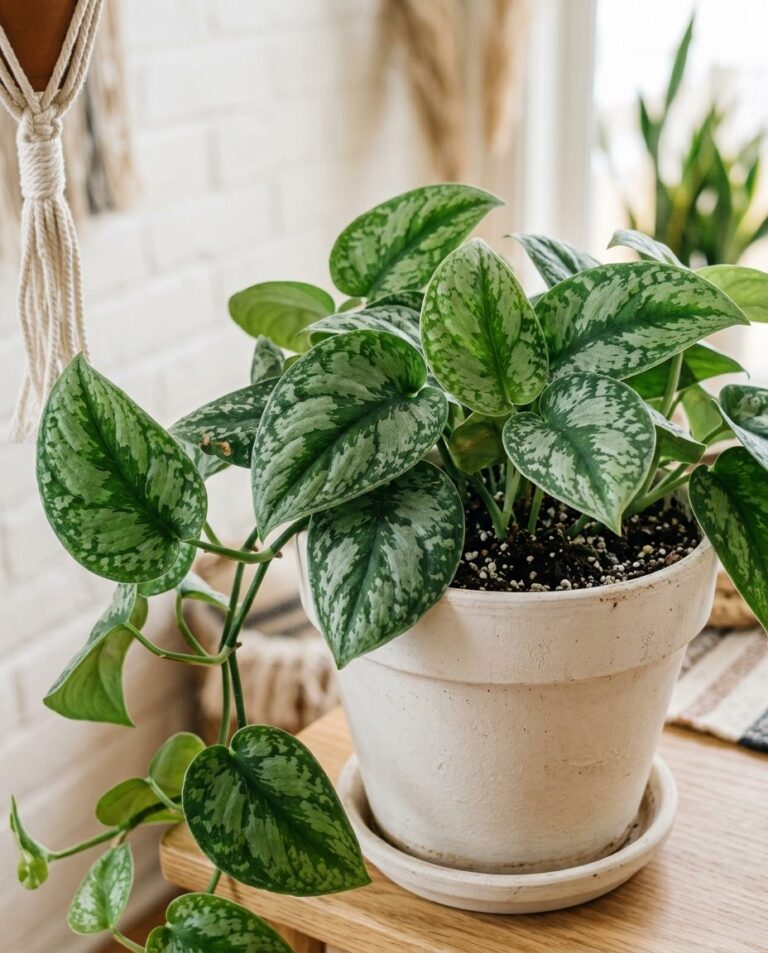
A substrate formulation of 50% peat-based potting mix, 30% perlite, and 20% orchid bark provides the aeration and moisture retention balance optimal for Scindapsus pictus root physiology. The peat component (or coir substitute) holds sufficient moisture for 7-10 day watering intervals, while perlite creates air pockets that prevent waterlogging in the shallow root zone. Orchid bark chunks (6-9 mm diameter) maintain structure over 18-24 months before decomposing, longer than the 12-month lifespan of peat alone. This ratio produces a substrate that dries from top to bottom in a gradient, allowing the surface 5 cm to reach dryness while the 10-15 cm depth retains slight moisture, matching the plant’s natural rooting pattern.
Canadian garden centres in Ontario and Quebec stock pre-mixed “tropical plant” substrates that typically contain 60-70% peat and 30-40% perlite, lacking the bark component critical for long-term structure. Purchasing these mixes and amending with 20% by volume orchid bark (available in the orchid supply section) creates a superior medium. Alternatively, mixing equal parts of standard potting soil, perlite, and orchid bark produces a slightly coarser texture that works well for mature Scindapsus pictus specimens. Avoid mixes containing water-retaining crystals or gels, as these create localized saturation pockets that suffocate roots. The substrate pH should fall between 5.5-6.5; most peat-based mixes in Canada naturally land in this range without adjustment.
Testing Substrate Drainage Performance
Before potting, test substrate drainage by filling a container, saturating it completely, then allowing it to drain for 30 minutes. Squeeze a handful of the drained substrate; it should release only 1-2 drops of water and crumble when pressure is released. If water streams out or the substrate remains compacted in a ball, increase perlite content by 10% increments until achieving the target consistency. This test proves particularly valuable in British Columbia, where high-rainfall regions have access to locally produced composts that may retain excessive moisture compared to standardized commercial mixes. Growers in Alberta report that adding 5-10% coarse sand (2-3 mm particle size) to the standard recipe further improves drainage in the low-humidity conditions typical of Prairie provinces.
Humidity and Temperature Ranges for Optimal Growth Indoors
Scindapsus pictus maintains healthy foliage in the 40-60% relative humidity range common in Canadian homes, a significant advantage over humidity-demanding tropicals. The papillae covering leaf surfaces reduce water loss, allowing this species to tolerate the 30-35% humidity levels typical in Saskatchewan and Manitoba homes during January and February heating seasons without developing brown leaf edges. However, growth rate and leaf size increase measurably when humidity reaches 50-60%. In Ontario apartments, placing Scindapsus pictus in bathrooms with regular shower use or grouping multiple plants to create a localized humid microclimate produces leaves 15-20% larger than specimens grown in 35% humidity living rooms.
Temperature tolerance spans 15-29°C, with optimal growth occurring between 18-24°C. Below 15°C, root activity ceases and watering frequency must drop to every 14-18 days to prevent substrate saturation. This becomes relevant in Quebec and Atlantic Canada homes where nighttime temperatures near windows can drop to 12-14°C during cold snaps. Moving plants 50-100 cm away from windows during extreme cold prevents this temperature stress. Above 27°C, transpiration increases and watering frequency must adjust to every 5-6 days; this scenario occurs in south-facing Alberta apartments during summer months when afternoon temperatures can reach 28-30°C near windows.
Winter Temperature Management in Canadian Homes
Forced-air heating systems common in Canadian construction create temperature fluctuations that stress tropical plants. Scindapsus pictus positioned directly above heating vents experiences 5-8°C temperature swings within 30-minute cycles, leading to leaf curling and slowed growth even when average room temperature remains optimal. Relocating plants 1-2 metres from heat sources or using deflectors to redirect airflow eliminates this issue. In Yukon and Northwest Territories, where heating systems operate continuously from October through April, maintaining consistent 19-21°C temperatures proves easier than in southern provinces with intermittent heating, resulting in paradoxically better Scindapsus growth despite extreme outdoor cold.
Propagation Methods: Stem Cuttings Versus Node Selection for Success Rate
Node selection determines propagation success more than any other factor with Scindapsus pictus. Each cutting requires at minimum one node, the slightly swollen point on the stem where leaves attach and roots emerge. Single-node cuttings with one attached leaf root successfully 85-90% of the time when taken from actively growing stem tips, compared to 60-70% success for cuttings from older, woody stem sections. The node must show a visible aerial root bump (appearing as a small brown protrusion 1-2 mm long) for optimal rooting; nodes lacking this visible primordium take 2-3 weeks longer to produce roots and show higher failure rates in Canadian winter conditions when growth hormones are less active.
Internodal cuttings, taken between nodes, fail to root in Scindapsus pictus regardless of rooting hormone application, unlike some Epipremnum species that can generate adventitious roots from internodal tissue. This represents a critical distinction for Canadian growers accustomed to propagating Golden Pothos. When preparing cuttings, use sterilized scissors or pruning shears (wiped with 70% isopropyl alcohol) to make cuts 1 cm below the node at a 45-degree angle. This angled cut increases surface area for water uptake and prevents the cutting from sitting flat against container bottoms, which can cause rot. Remove the lowest leaf if present, leaving 1-2 leaves above to support photosynthesis during root development.
Water Versus Soil Propagation Success Rates
Water propagation produces visible roots in 10-14 days at 21-24°C, with 90-95% success rates for tip cuttings with visible aerial root bumps. Place cuttings in clean glass containers with 5-7 cm of dechlorinated water, positioning nodes 2-3 cm below the surface. Change water every 3-4 days to prevent bacterial growth. In Ontario homes, placing propagation containers on top of refrigerators or near (not on) heating vents maintains the 22-24°C bottom heat that accelerates rooting. Once roots reach 3-5 cm length (typically 18-25 days), transition cuttings to substrate within 48 hours; roots longer than 6 cm become fragile and break during potting, reducing survival rates to 70-75%.
Direct soil propagation eliminates the transplant shock of moving water-rooted cuttings to substrate but shows lower initial success rates of 75-80%. Insert cuttings 2-3 cm deep into moistened propagation mix (70% perlite, 30% peat), firm substrate around the node, and maintain consistent moisture without saturation. Clear plastic bags or containers create humidity chambers that raise success rates to 85-90% by reducing transpiration stress. In British Columbia coastal regions where ambient humidity naturally exceeds 55%, these chambers are unnecessary. Roots develop in 3-4 weeks with soil propagation, longer than water methods, but the resulting plants establish faster with less transplant setback.
Identifying and Resolving Yellowing Leaves and Curled Foliage
Yellowing leaves on Scindapsus pictus indicate either overwatering or nitrogen deficiency, distinguished by the pattern and progression of discolouration. Overwatering yellowing begins with older, lower leaves turning uniformly pale yellow over 5-7 days, often accompanied by a musty odour from the substrate and soft, brown roots visible when the plant is unpotted. This occurs most frequently in Quebec and Ontario during November-December when reduced light slows water uptake but growers maintain summer watering schedules. Substrate remains wet 4-5 cm below the surface for 10+ days, creating the anaerobic conditions that damage roots. Resolution requires immediate reduction of watering frequency to every 12-15 days and verification of drainage hole function.
Nitrogen deficiency yellowing also affects older leaves first but progresses more slowly over 3-4 weeks, with leaves remaining firm and attached rather than dropping readily. New growth emerges pale green or yellow-green rather than the deep green typical of healthy Scindapsus. This pattern appears in specimens grown in the same substrate for 18+ months without fertilization, as the limited nitrogen in peat-based mixes depletes. Application of balanced liquid fertilizer at half-strength (10-10-10 NPK ratio) resolves symptoms within 2-3 weeks, with new leaves returning to normal colouration while affected older leaves remain yellow and eventually drop.
Leaf Curling and Edge Browning Diagnosis
Inward leaf curling along the length of the leaf indicates underwatering or excessively low humidity, while downward curling at leaf tips suggests salt accumulation from hard water or over-fertilization. Underwatering curl develops over 2-3 days when substrate dries completely through the root zone, causing leaves to curl tightly to reduce surface area and conserve moisture. This proves more common in Alberta and Saskatchewan where low humidity accelerates drying. Thorough watering until runoff appears, followed by adjustment to a 7-8 day schedule, reverses the curling within 48 hours. Salt accumulation curl develops gradually over weeks, with white or tan crusty deposits visible on substrate surfaces and leaf tips turning brown and crispy. Flushing the pot with 3-4 times its volume of distilled water dissolves accumulated salts; repeating this flush every 2-3 months prevents recurrence in areas with hard water.
Repotting Intervals and Root-Bound Tolerance in Scindapsus
Scindapsus pictus tolerates and even prefers slightly root-bound conditions, thriving for 2-3 years in the same pot size that would constrain faster-growing vines. The shallow, fibrous root system reaches maximum density at approximately 80% pot volume occupation, a state that stimulates more compact growth and enhanced variegation compared to specimens in oversized containers. Visual indicators for repotting include roots circling visibly at drainage holes, water running straight through the pot without substrate absorption, and slowed growth despite adequate light and fertilization. In Ontario conditions, a Scindapsus pictus in a 12 cm pot typically requires upsizing to 15 cm after 24-30 months, a longer interval than the 12-18 months standard for Epipremnum aureum.
Repotting timing in Canada ideally occurs in April-May when increasing day length and temperature stimulate root growth, allowing rapid establishment in fresh substrate. Repotting during October-February results in slower root expansion and higher risk of substrate saturation, as the plant’s reduced metabolic activity cannot utilize available moisture efficiently. When repotting, increase pot diameter by only 2-3 cm; moving from a 12 cm to an 18 cm pot creates excessive substrate volume that remains wet in the bottom third, beyond root reach. The shallow root habit of Scindapsus means a wider, shorter pot (15 cm diameter × 12 cm depth) outperforms a standard deep pot (15 cm diameter × 15 cm depth) by providing more lateral root expansion space while minimizing unused substrate depth.
Root Pruning for Mature Specimens
Mature Scindapsus pictus specimens exceeding 200 cm length can be maintained indefinitely in 15-18 cm pots through root pruning rather than continuous upsizing. Remove the plant from its pot in spring, use sterilized pruning shears to trim away the outer 2-3 cm of the root ball (approximately 30% of total root mass), and repot in the same container with fresh substrate. This technique, practiced by growers in British Columbia botanical collections, stimulates new feeder root growth while maintaining manageable plant size. The shallow root system of Scindapsus tolerates this pruning better than deep-rooted species, with plants resuming growth within 2-3 weeks. Water sparingly (every 10-12 days) for the first month post-pruning to prevent rot while new roots establish.
Fertilization Schedule and Nutrient Deficiency Symptoms
A balanced liquid fertilizer with NPK ratio of 10-10-10 or 20-20-20, diluted to half the manufacturer’s recommended strength, applied every 4-6 weeks from March through September provides adequate nutrition for Scindapsus pictus. The slower growth rate compared to Epipremnum species means this vine requires 40-50% less fertilizer than commonly recommended for generic “pothos” care. In Quebec and Ontario, beginning fertilization in mid-March when day length exceeds 12 hours aligns with the plant’s natural growth acceleration. Cease fertilization in October as growth slows; applying fertilizer during November-February when root activity is minimal leads to salt accumulation without providing benefit.
Nitrogen deficiency manifests as uniform yellowing of older leaves while new growth remains small and pale, typically appearing 18-24 months after the last repotting as substrate nitrogen depletes. Phosphorus deficiency, rare in Scindapsus but occasionally seen in specimens grown exclusively in coir-based substrates, causes dark green leaves with purple-tinged undersides and stunted growth. A single application of bloom-formula fertilizer (5-10-5 NPK) corrects this within 3-4 weeks. Potassium deficiency appears as yellowing leaf edges progressing inward, with affected tissue eventually turning brown and crispy; this occurs most often in Alberta when hard water leaches potassium from substrate over time. Switching to a fertilizer with elevated potassium (15-5-15 NPK) for 2-3 applications resolves the deficiency.
Organic Versus Synthetic Fertilizer Performance
Synthetic liquid fertilizers provide immediately available nutrients that produce visible growth response within 7-10 days, making them ideal for correcting deficiencies. Organic options like fish emulsion (5-1-1 NPK) or kelp-based fertilizers release nutrients more slowly over 3-4 weeks, reducing the risk of over-fertilization but requiring more frequent application. In British Columbia, where organic gardening products are widely available, alternating between synthetic fertilizer (every 6 weeks) and organic amendments (every 3 weeks) provides both immediate and sustained nutrition. Slow-release granular fertilizers, while convenient, often concentrate in the shallow root zone of Scindapsus pictus, creating localized high-salt areas that damage roots. If using granular products, reduce application rate to 50% of label recommendations and distribute granules evenly across the substrate surface rather than concentrating near the stem.